
Last updated September 20, 2026
Free on-site gate assessment - hinges, posts, and your LiftMaster or Nice gate operator checked before anything is quoted
The assessment is free and the quote is the invoice.

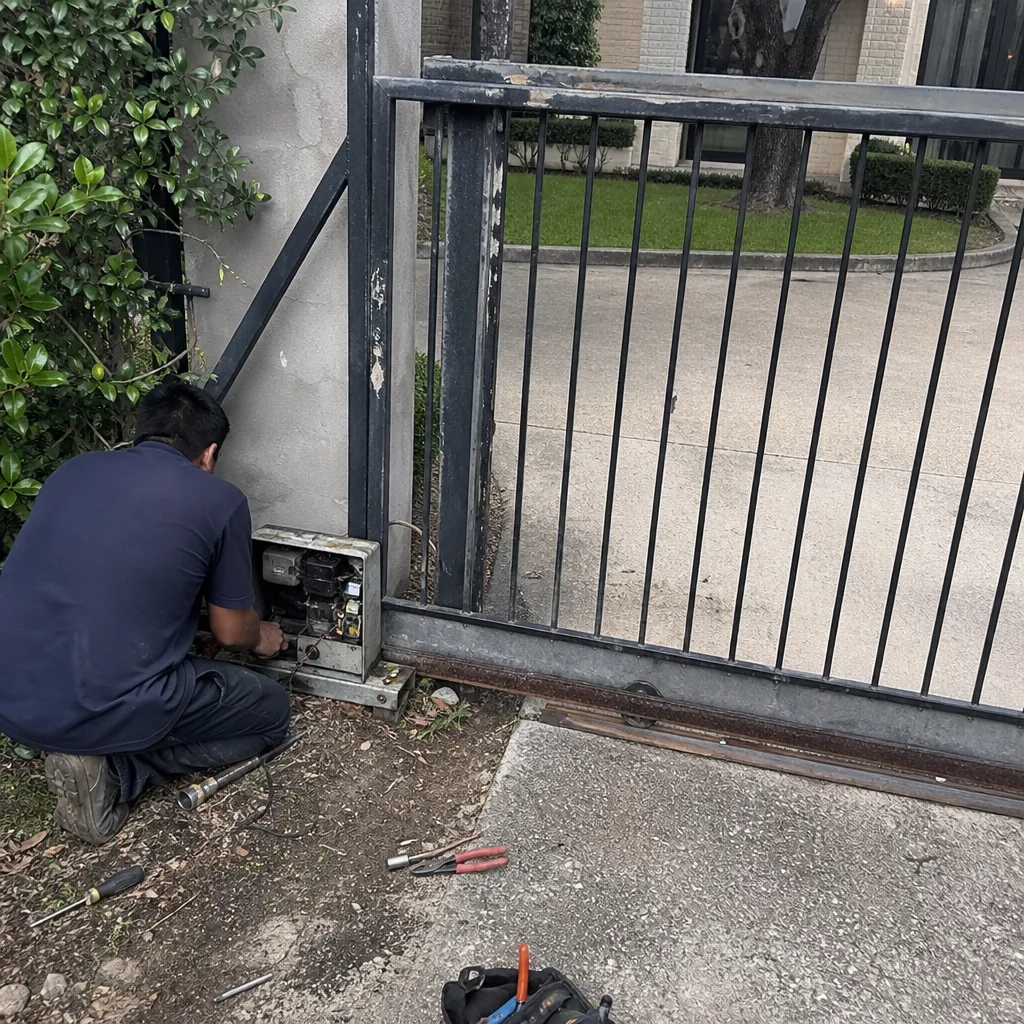 Before
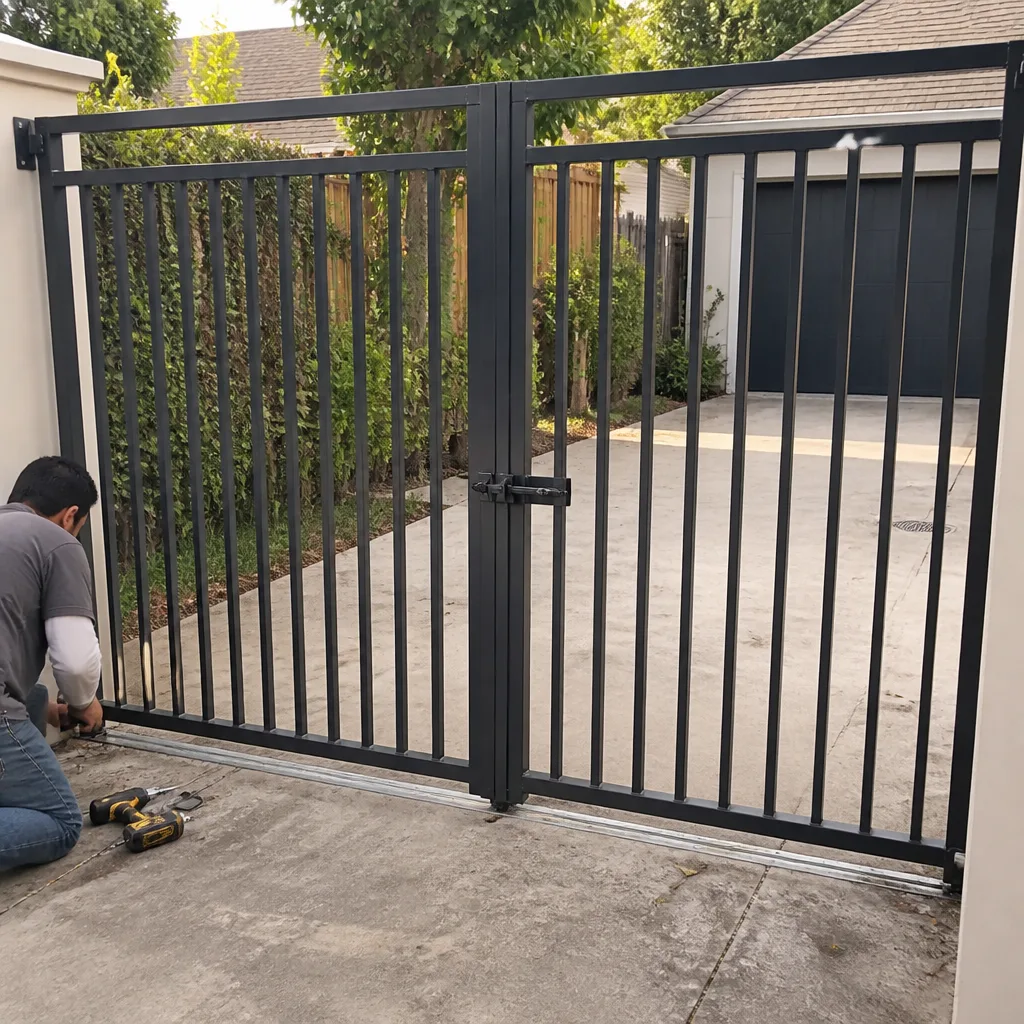 After
After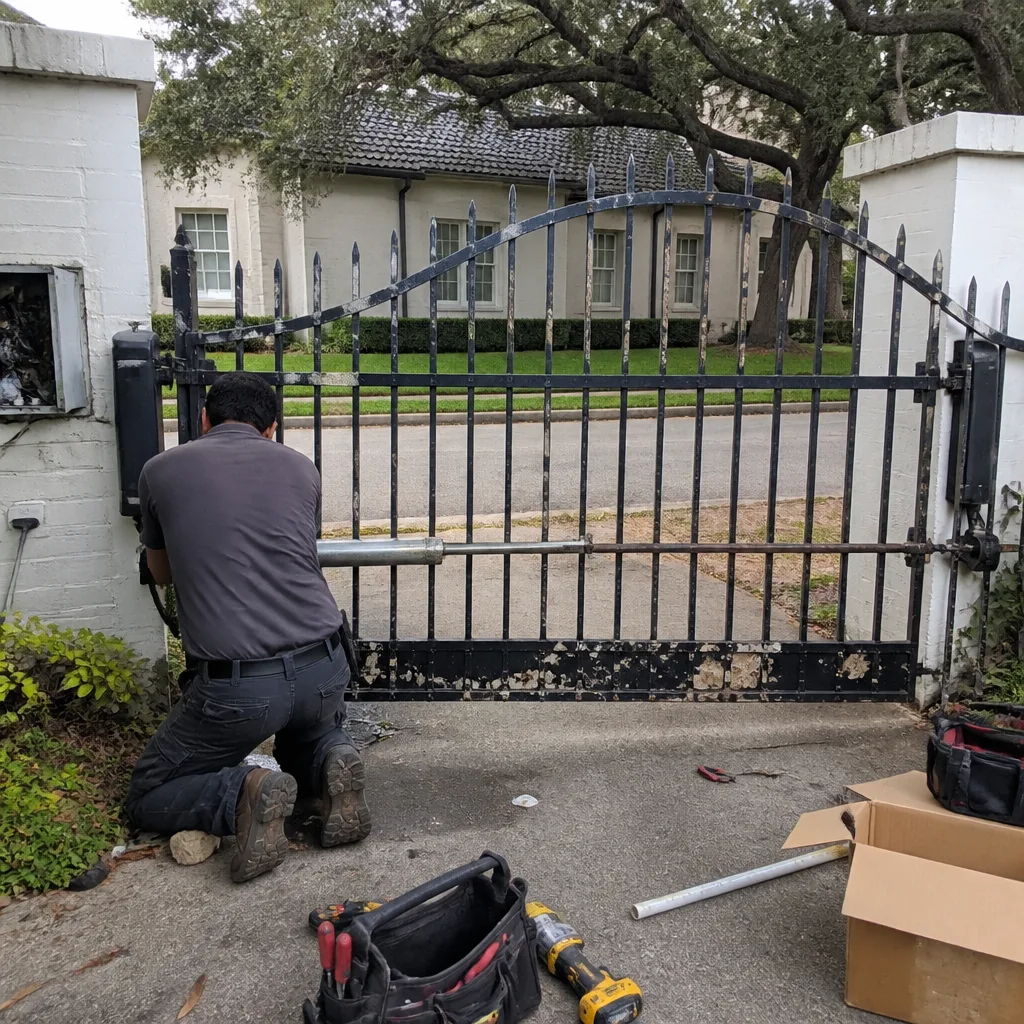 Before
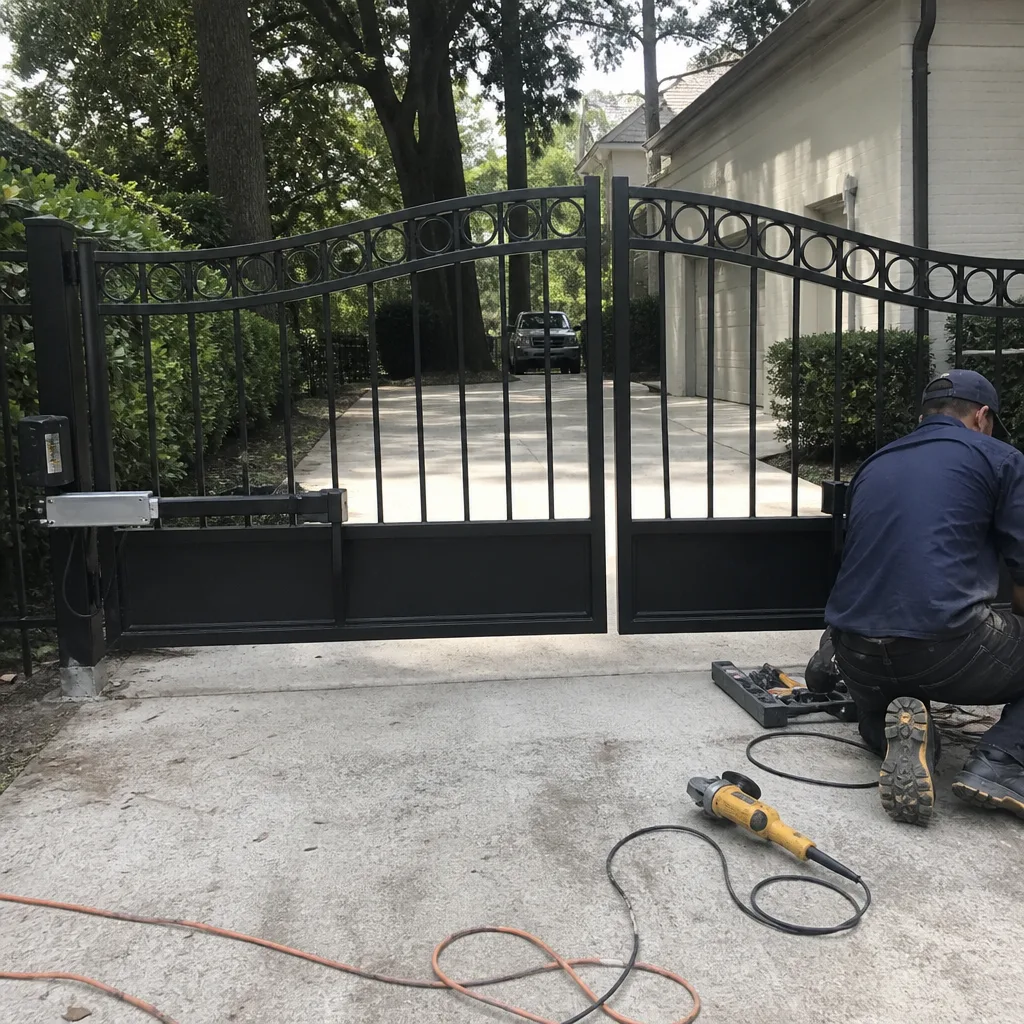 After
After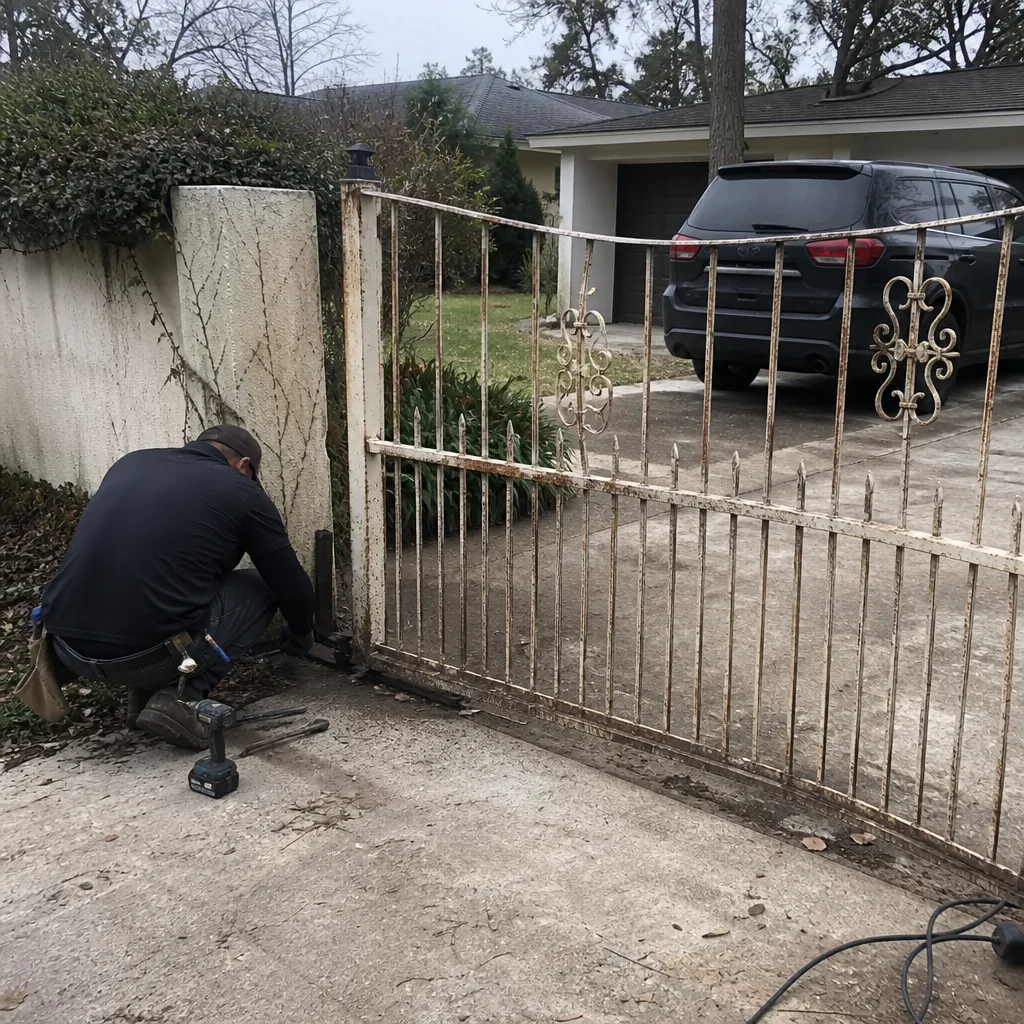 Before
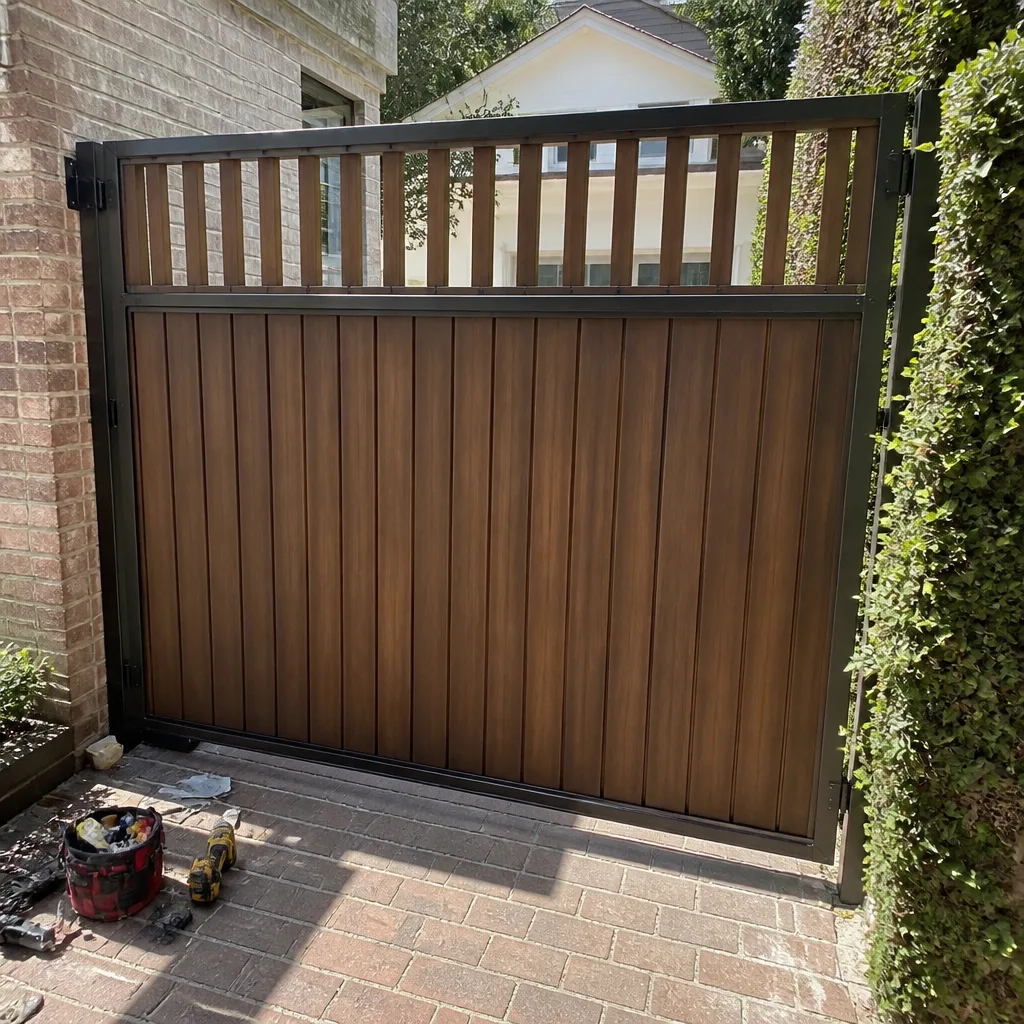 After
AfterGate Repair Cost Breakdown: The West University Place Homeowner’s Reference for 2026
The reason two gate repair quotes in West University Place can differ by $800 for what sounds like the same job isn’t that one company is greedy and the other is generous. It’s that without a written scope, each contractor is quietly quoting a different job even while standing in front of the same gate. One is pricing a control board swap. The other is pricing a full operator replacement with new battery backup and a safety-edge retrofit, assuming that’s what “fix the gate” means. This Gate Repair guide gives you the actual 2026 cost structure by component, by labor model, and by failure scenario so you can read a quote the way a technician reads it, line by line. By the end, you’ll know what a fair repair costs in West University Place, what drives the price up, and how to make two competing bids genuinely comparable.
Quick Answer
Gate repair in West University Place, TX typically costs between $185 and $1,400 in 2026, with most homeowners paying $275 to $650 for a single-component repair like a hinge replacement, limit-switch adjustment, or receiver board swap. A full operator replacement on a swing or slide gate runs $900 to $2,800 installed depending on the motor brand, gate weight, and whether new safety edges or battery backup are included. The single most effective way to control that number is to get a written scope with part-level pricing before anyone picks up a tool.
Table of Contents
- What Each Gate Component Costs to Replace in West University Place
- How Labor Is Actually Priced: Diagnostic Flat Fee vs. Flat-Rate Repair
- The Three Cost Events That Turn a $300 Repair Into a $1,200 Repair
- How a Written Scope with Change-Order Language Protects Your Budget
- What a Documented Gate Service Record Is Worth at Resale
- How to Compare Two Written Quotes Line by Line
- Common Mistakes to Avoid
- When to Call a Professional
- Frequently Asked Questions
- The Bottom Line
BeforeAfterWhat Each Gate Component Costs to Replace in West University Place
Before you can evaluate any quote, you need to know what the parts actually cost. Not the contractor’s wholesale cost, which you’ll never see and which is irrelevant to your bill. We mean the installed price you should expect to see on a written estimate in the West University Place market in 2026. These are part-level ranges for the most commonly replaced components on residential driveway gates in the area. They reflect what we see on service calls across West University Place and the surrounding neighborhoods week after week.
Here is the component-by-component picture:
- Operator (motor) replacement: $900 to $2,800 installed. A basic AC swing-arm operator starts around $900. A DC-powered slide-gate operator with soft start and stop from a brand like BFT or Linear lands between $1,400 and $2,200. Heavy-duty operators for oversized or custom iron gates in West University Place’s larger lots can push past $2,500.
- Control board replacement: $325 to $750 installed. The board is the brain that reads the limit switches, the photo-eyes, and the remote inputs. A board swap is often the right fix for a gate that stopped responding to remotes but still has power.
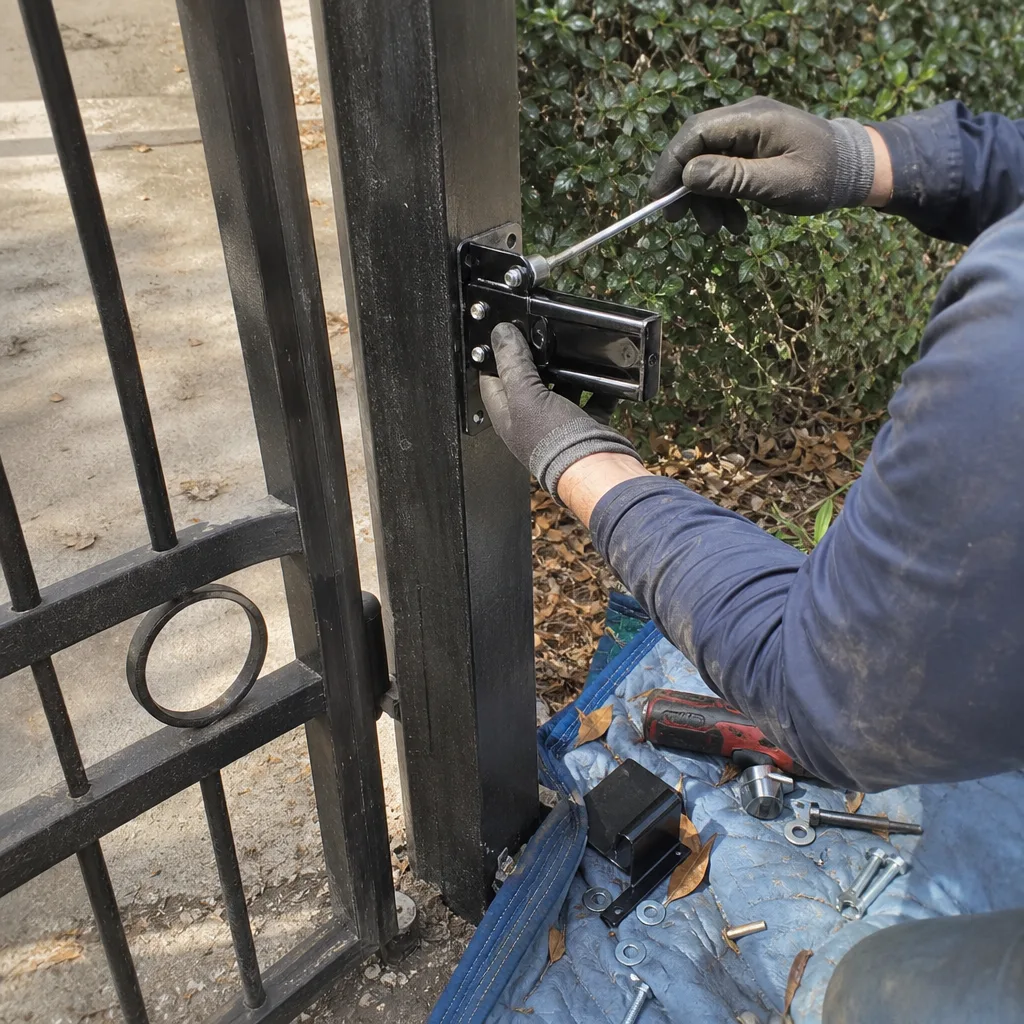
- Hinge replacement (single): $185 to $420 installed, depending on whether the post is solid, the gate is steel or ornamental iron, and whether welding is required. Several West University Place homes have older iron gates where hinge pins have worn elliptical over 15 or 20 years of Houston humidity.
- Limit switch replacement or reset: $95 to $280. This is frequently a diagnostic adjustment rather than a replacement. A limit switch that is set even a few degrees past travel will cause the motor to grind, overheat, and eventually burn out.
- Battery backup replacement: $260 to $520 installed. In West University Place, where thunderstorms and hurricane-season outages are a reality, battery backup on a gate opener is not a luxury. Batteries degrade over three to five years, and a failed battery often masquerades as a board problem.
- Photo-eye replacement or realignment: $140 to $310. A photo-eye (the infrared beam that stops the gate if something crosses the path) that’s been knocked out of alignment by a mower or a bad storm will cause the gate to refuse to close or to reverse mid-cycle.
- Remote receiver or keypad replacement: $165 to $390 installed. Interference, water intrusion, or simple age kills receivers. A new keypad adds convenience but requires programming to match the existing operator.
These are installed prices, meaning the part plus the labor to put it in. When you see a quote that bundles “gate repair” into a single line item with no part-level detail, you cannot verify what you’re actually paying for. That’s the opacity problem this guide exists to fix. For a broader look at the repair services we cover, see our Gate Repair in West University Place page.
How Labor Is Actually Priced: Diagnostic Flat Fee vs. Flat-Rate Repair
There are two legitimate ways a gate company in West University Place structures labor, and they produce very different-looking invoices. Neither is dishonest on its face. The problem is that most homeowners don’t know which model they’re being quoted under, which makes it impossible to compare quotes or predict the final bill.
The first model is diagnostic flat fee plus time and materials. Under this structure, you pay a set fee, typically $75 to $150 in West University Place, for a technician to come out, diagnose the problem, and tell you what the repair will cost. If you approve, you then pay an hourly rate (commonly $95 to $160 per hour locally) plus the cost of parts. This model is transparent if the technician documents the diagnosis clearly. It gets expensive if the diagnosis is wrong, because you’re paying for the wrong fix and then paying again for the right one.
The second model is flat-rate per repair. The company quotes you a single price for a specific repair: “$485, control board replacement, installed, with a one-year part warranty.” It doesn’t matter if the job takes 40 minutes or three hours. You know the price before work begins. This is the model that works best for homeowners who want certainty, and it’s the model we use at Vance Gate Repair West University Place. The written price you receive before we start is the price you pay when we leave. No hourly surprises.
Here’s what to ask any company you’re considering:
- Is this a diagnostic fee that gets applied to the repair, or is it in addition to the repair?
- What is your hourly rate if the job runs long, and what’s the definition of “runs long”?
- Does the flat rate include any required incidental parts, like wire nuts, connectors, and sealant?
- If the fix fails within 30 days, is the follow-up diagnostic free?
The answer to question four tells you more about a company than anything else on its website.
The Three Cost Events That Turn a $300 Repair Into a $1,200 Repair
Most gate repair horror stories in West University Place follow the same arc. A homeowner calls about a gate that won’t close. The initial quote sounds reasonable. The final invoice is four times higher. The homeowner feels fleeced. But here’s what actually happened, nearly every time: three specific cost events occurred, none of which were disclosed before work started. Understanding these events is the difference between a controlled repair and an open-ended bill.
Cost Event One: The discovered secondary failure. The technician opens the control box to replace a $290 board and finds that a failed battery backup leaked acid across the wiring, or that the limit switch had been set incorrectly for so long that the motor gear is stripped. Each new discovery adds parts and labor. This is legitimate, but it should never come as a surprise. A competent diagnosis usually anticipates the secondary failure. A weak diagnosis discovers it halfway through the job, after you’ve already committed.
Cost Event Two: The unquoted “upgrade.” The technician determines that the existing photo-eyes are “outdated” or “not up to current code” and recommends replacing them for an additional $400. Or the keypad “isn’t compatible” with the new board, so that’s another $350. Some of these recommendations are real safety improvements. Some are padding. Without a written scope that specifies exactly what is and is not included-and that accounts for Gate Repair Permits, Codes & Inspections in TX: What You Need to Know-you cannot tell the difference from a verbal explanation. You’re at the mercy of the person holding the screwdriver.
Cost Event Three: The change order without change-order language. Mid-repair, the scope changes. The hinge replacement requires welding that wasn’t anticipated. The underground wiring is compromised and needs a new conduit run. When there is no written change-order process, the technician just does the work and tells you about it afterward. You are now negotiating from a position of zero leverage because the work is already done. A proper written scope includes change-order language: any additional work beyond the written scope requires a written addendum and your signature before it begins.
Each of these cost events is preventable with one document: a written scope with part-level pricing and explicit change-order terms. That’s not just good practice. In our experience across thousands of gates since 2014, it is the single biggest predictor of whether a homeowner ends the job satisfied or feels taken.
How a Written Scope with Change-Order Language Protects Your Budget
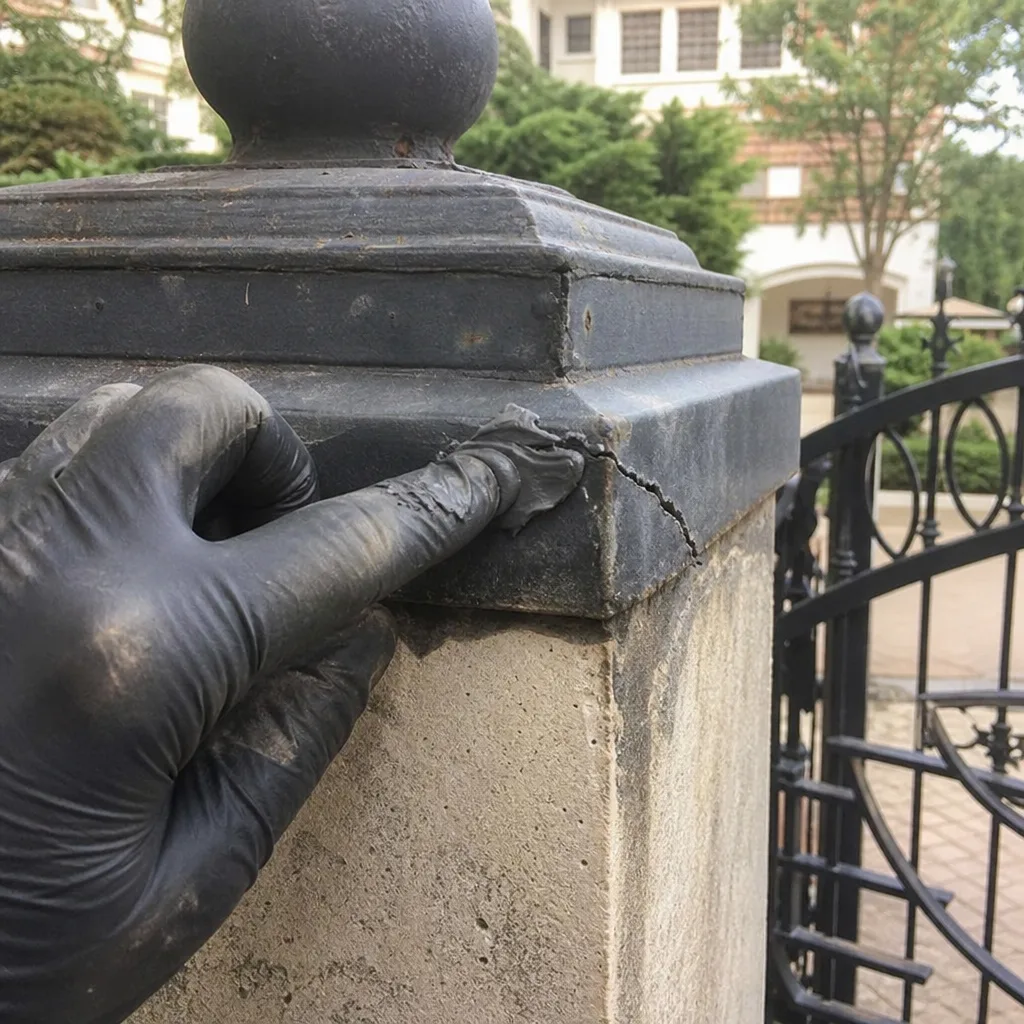
The written scope is not a piece of paper. It’s a boundary. It defines the job in physical terms: this part, this labor, this price. It defines what is not included. And it defines what happens when reality doesn’t match the original diagnosis. Without it, every gate repair in West University Place is a handshake and a hope.
A proper written scope should contain these elements:
- Part-level breakdown: The exact part number or specification for every component being replaced, the quantity, and the unit price. Not “gate motor” but “BFT Deimos BT A400 swing operator, 24V, installed.”
- Labor description: What the technician will do, in plain language, with enough detail that another technician could pick up the document and finish the job. “Remove existing operator, install new operator, set limit switches, test full cycle, program two remotes.”
- Photo documentation clause: The scope states that before-and-after photos of the repair area will be provided. This protects you if something looks wrong later. It also creates a record for any future technician.
- Change-order language: The specific sentence that says additional work discovered during the repair will be paused, documented, quoted in writing, and only performed after your approval. This single sentence prevents Cost Events One, Two, and Three from ambushing your budget.
- Warranty terms: What’s covered, for how long, and what’s excluded. Labor warranty and part warranty are often different. Know both.
At Vance Gate Repair West University Place, we operate under a set of customer protections we call the Haven Standard. Clause 1 is simple: the price is in writing before any work begins. Clause 4 states that every job includes a documented photo record of what was found, what was set, and what was installed. You leave every service call with a written record. No future technician has to guess what was done, and you never pay twice to rediscover the same problem. Our Vance Gate Repair West University Place home page covers the full standard if you want the details.
What a Documented Gate Service Record Is Worth at Resale
West University Place is a market where buyers notice details. A well-maintained automated gate is a listed feature. A gate that opens slowly, groans on its hinges, or has a keypad with sun-faded buttons is a line item in a buyer’s negotiation. Here’s what most sellers don’t realize: the service record for that gate has real dollar value at the closing table.
When a buyer’s inspector flags the gate operator as “age unknown, condition uncertain,” the buyer’s agent asks for a credit. The seller, who hasn’t touched the gate in six years, has nothing to show. The credit request lands somewhere between $800 and $1,500 because that’s the assumed cost to make it right, and neither side has evidence to contest the number. The seller eats it.
Now consider the same transaction with a documented service history. The seller hands over a folder with dated photo logs of every repair, part numbers for every replacement, and a written record of the last service visit eight months prior showing the operator tested within spec, battery backup at 85% capacity, and hinges lubricated with no play detected. The inspector’s comment becomes “gate serviced regularly, documentation on file.” The buyer’s agent loses the leverage to demand a generic credit. The folder paid for itself several times over.
If you intend to sell a home in West University Place in the next five years, start treating gate maintenance like furnace maintenance. Keep the records. Keep the photos. The repair you perform today with proper documentation is an asset at resale, not just an expense. And if you’re buying, ask the seller for the gate’s service history before you sign. The absence of one is information in itself.
How to Compare Two Written Quotes Line by Line
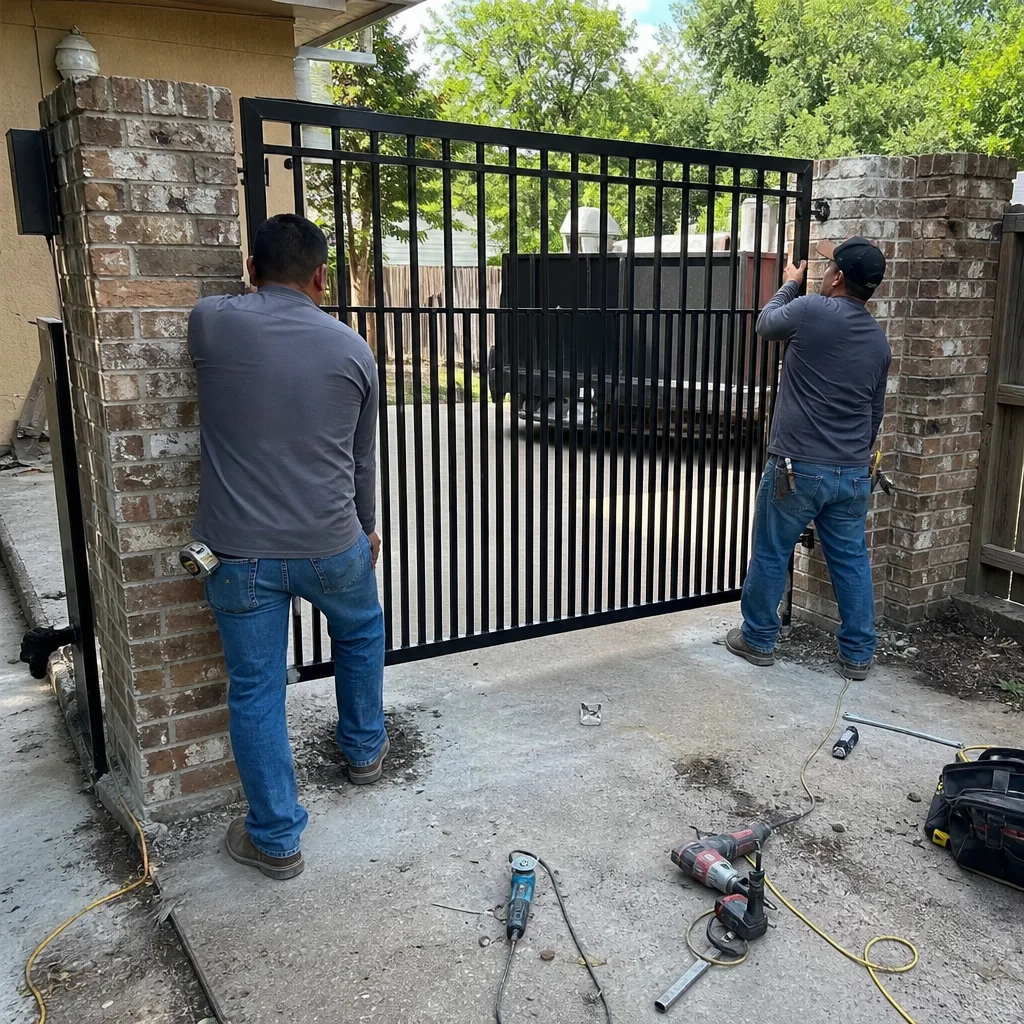
Most homeowners compare quotes by looking at the bottom-line number. That is the least informative comparison you can make. Two quotes for the same repair can differ by $900 and still both be honest. The difference lies in what each quote is actually promising to do. The line-item framework below turns an apples-to-oranges comparison into something you can evaluate.
Here’s the comparison method we recommend to any West University Place homeowner holding two written estimates:
- Compare the part numbers first. If Quote A specifies “BFT A400 operator, installed” and Quote B just says “gate motor replacement,” you are not comparing the same product. Quote B might be a lesser motor, a rebuilt unit, or the same motor with no brand commitment. You can’t know, and that’s the point.
- Check for line-item omissions. Does Quote A include the photo-eye realignment that Quote B lists separately? Does Quote B include the new remote that Quote A assumes you’ll program yourself? An omission isn’t deception, but it changes the real cost. Add back the omitted items before comparing.
- Confirm the labor boundary. What happens if the job is more involved than quoted? Quote A should have change-order language. Quote B’s silence on the topic means the contractor reserves the right to adjust the price verbally. Silence has a cost.
- Verify the warranty terms. A one-year parts-and-labor warranty is meaningfully different from a 90-day parts-only warranty. Price differences often hide here. A $200-cheaper quote with a 90-day warranty is not cheaper if the repair fails in month four.
- Ask about documentation. Does the quote include a written record of what was installed, with part numbers and photos? If not, you’ll pay for the diagnosis again the next time something fails. The cheapest quote with no documentation is often the most expensive repair over five years.
We see a lot of written estimates from other companies in West University Place, because one of our standard practices is a free second opinion on any written quote you bring us. When the line items match, the comparison is easy. When they don’t, the missing lines tell you more than the totals ever will. For context on what goes into a full gate project, our Gate Installation in West University Place page covers new-build pricing separately from repair work.
Common Mistakes to Avoid
- Approving a verbal quote. A quote delivered over the phone and not written down is not a quote. It’s a conversation. In West University Place’s humid climate, where corrosion and storm damage often reveal secondary issues mid-repair, verbal quotes invite change-order ambushes. Insist on written scope and part numbers before work starts.
- Deferring a loud gate noise. A gate that scrapes, groans, or clunks is sending you a message about a failing hinge, a misaligned operator, or a limit switch set wrong. Every month of deferred maintenance adds wear to the motor and the mount. The $200 hinge job you skipped in March becomes an $1,800 operator replacement in October.
- Ignoring the battery backup. In West University Place, where storm-season outages are a certainty, a dead battery backup is invisible until the power goes out and your gate won’t budge. Test the battery once a year. Replace it every three to five. It’s cheaper than a motor replacement caused by a damaged board.
- Choosing a quote on price alone. The lowest bottom-line number often reflects omissions, not efficiency. A Gate Motor & Opener replacement quoted without safety-edge testing or remote programming included is not the same job as one that includes those line items. Compare line items, not totals.
- Not asking for documentation. If a technician replaced your control board and left without giving you a part number, a photo, or any written record, you own a mystery. The next time the gate fails, a different technician has to diagnose from scratch. Documentation is not a nice-to-have. It’s the difference between a repair and a recurring charge.
- Using a generic handyman for operator work. A gate operator involves electrical, mechanical, and safety-sensor systems. A handyman who can fix a fence board is not necessarily qualified to set limit switches or test a photo-eye’s detection pattern. The cost of an amateur operator repair shows up later, often in the form of a burnt control board or a gate that closes on a car.
- Skipping the change-order clause. If your written quote doesn’t say what happens when the technician finds additional damage, you’ve agreed to a blank check. Get the change-order language in writing, or get a different contractor.
When to Call a Professional
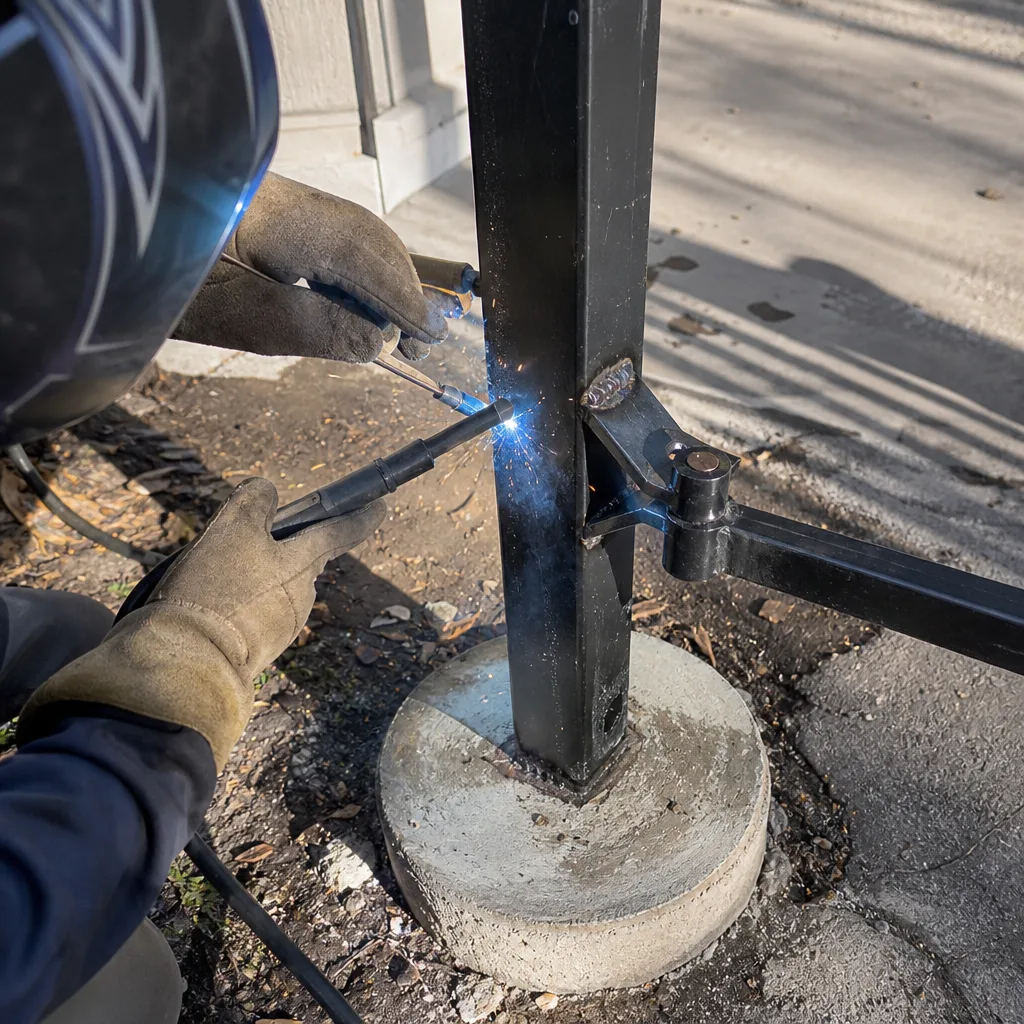
Some gate issues are safe to diagnose yourself: a remote with a dead battery, a keypad code that isn’t taking, a gate that’s visibly off its track and not moving. But the moment a repair involves the operator’s electrical components, the high-tension hardware, or the safety sensors, the risk shifts. A gate operator runs on line voltage, and a gate that weighs several hundred pounds carries serious force. Mis-wired control boards can short. Misaligned photo-eyes can fail to stop a closing gate at exactly the wrong moment. If your gate is making contact with the ground at the wrong angle, failing to reverse when something crosses the path, or the operator is hot to the touch, stop using it and call someone who carries a meter and a torque wrench. Vance Gate Repair West University Place offers free estimates in West University Place. Call (346) 375-5416 and a live person answers, any hour.
Frequently Asked Questions
Most gate repairs in West University Place cost between $275 and $650 for a single-component fix like a hinge replacement, limit-switch adjustment, or control board swap in 2026. Full operator replacements run $900 to $2,800 installed depending on the motor brand and gate specifications. Your exact price should be quoted in writing before work begins. Call (346) 375-5416 for a free estimate with part-level detail.
Yes, in most cases. We stock common repair parts on our trucks, and a live person answers (346) 375-5416 24/7 to schedule your visit. When the repair involves a specialized operator or a custom part, we’ll tell you the timeline upfront in writing, with the price, before you commit to anything.
We service nine major automation brands including Viking, BFT, Linear, and Ghost Controls, plus LiftMaster, FAAC, Mighty Mule, DoorKing, and Elite. We work on whatever motor is already on your property rather than steering you toward a replacement that might not be necessary. For details on motor-specific work, see our Gate Motor & Opener in West University Place page.
Quotes vary because different contractors are often quoting different scopes of work without saying so. One quote might include a new battery backup and photo-eye realignment while another quotes only the failed part. The only way to compare them is to get both in writing, line by line, with part numbers. Bring us any written estimate from another company and we’ll review it with you at no cost.
A quality operator from a brand like Linear or BFT should last 10 to 15 years in this climate if it’s sized correctly for the gate and maintained. The Houston-area humidity and occasional storm-surge conditions mean battery backups and control boards often fail before the motor itself. Regular limit-switch checks and hinge lubrication extend the life of the whole system, not just the operator.
Yes. We provide a written estimate at no charge, with part-level pricing and labor broken out, before any work begins. The price we quote is the price you pay. Call (346) 375-5416 to schedule a free estimate, and you’ll get a written scope you can hold onto whether or not you hire us.
The Bottom Line
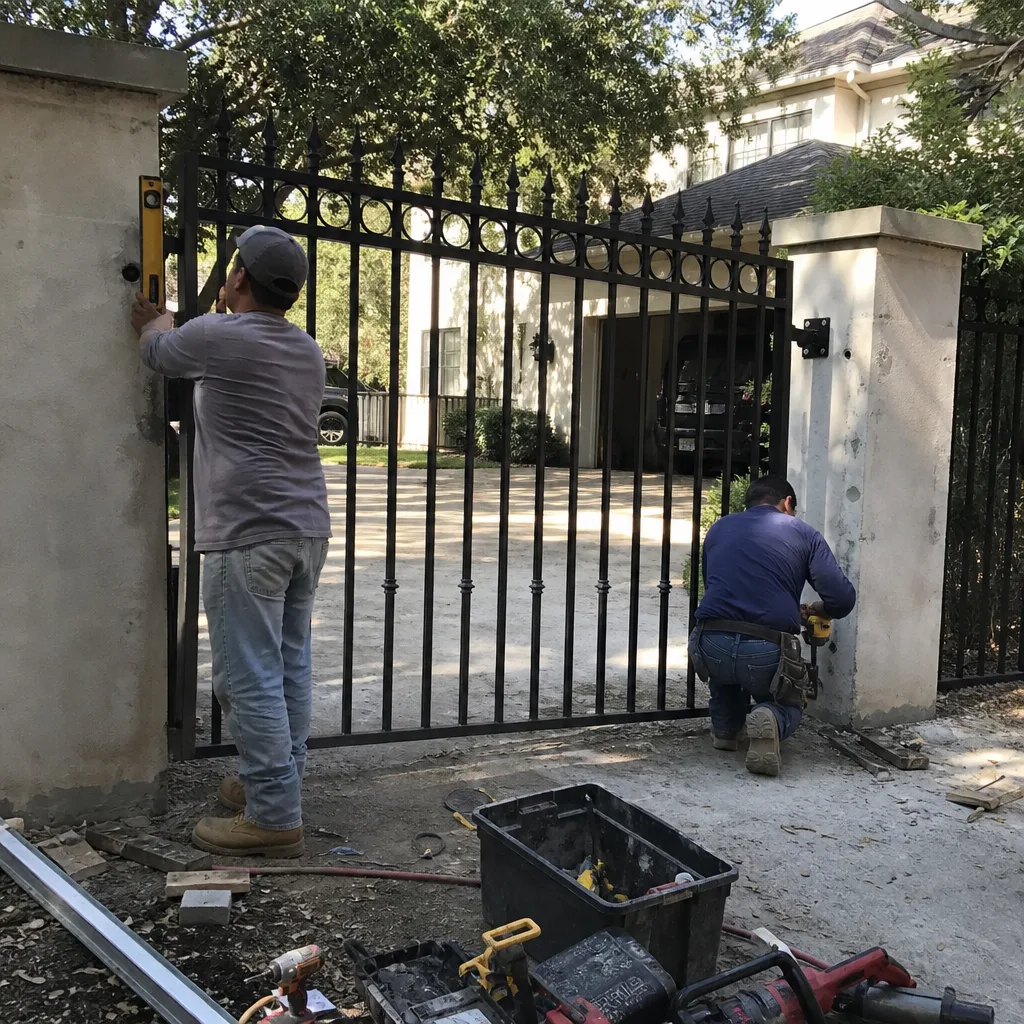
Gate repair pricing in West University Place is not mysterious. It’s just rarely explained. Once you understand that most repairs fall into predictable component-level price ranges, that labor is structured in two distinct models, and that the biggest cost risks come from undocumented scope changes, you can control your budget with a single document: a written scope with change-order language and part numbers. In 2026, the difference between a $300 repair and a $1,200 repair is almost never the failure itself. It’s whether the person holding the screwdriver wrote down what they were going to do before they did it. Ask for the paper. If a company won’t put it in writing, that’s your answer. For more guides & resources, visit our blog.
Written by Adrian Vance, Owner at Vance Gate Repair West University Place, serving West University Place since 2014.