
Last updated September 20, 2026
Free on-site gate assessment - hinges, posts, and your LiftMaster or Nice gate operator checked before anything is quoted
The assessment is free and the quote is the invoice.


 Before
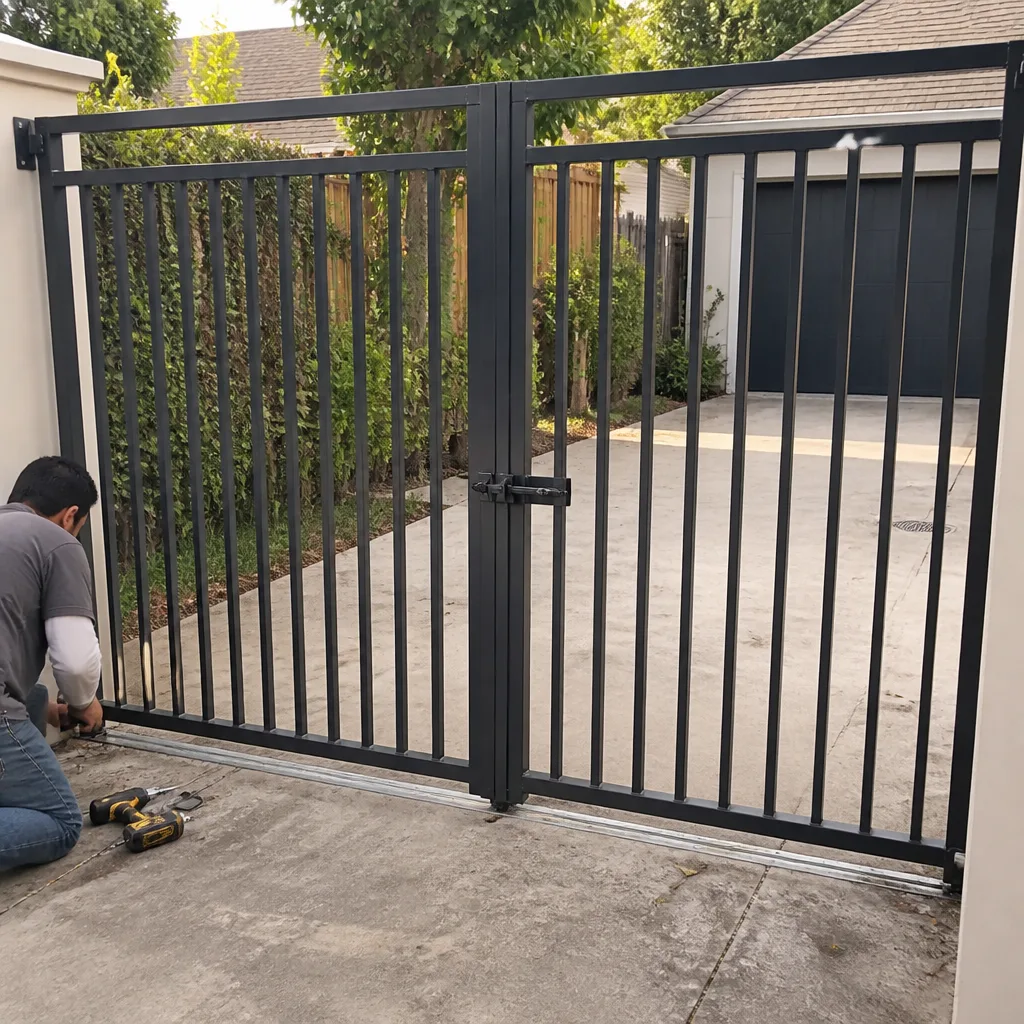 After
After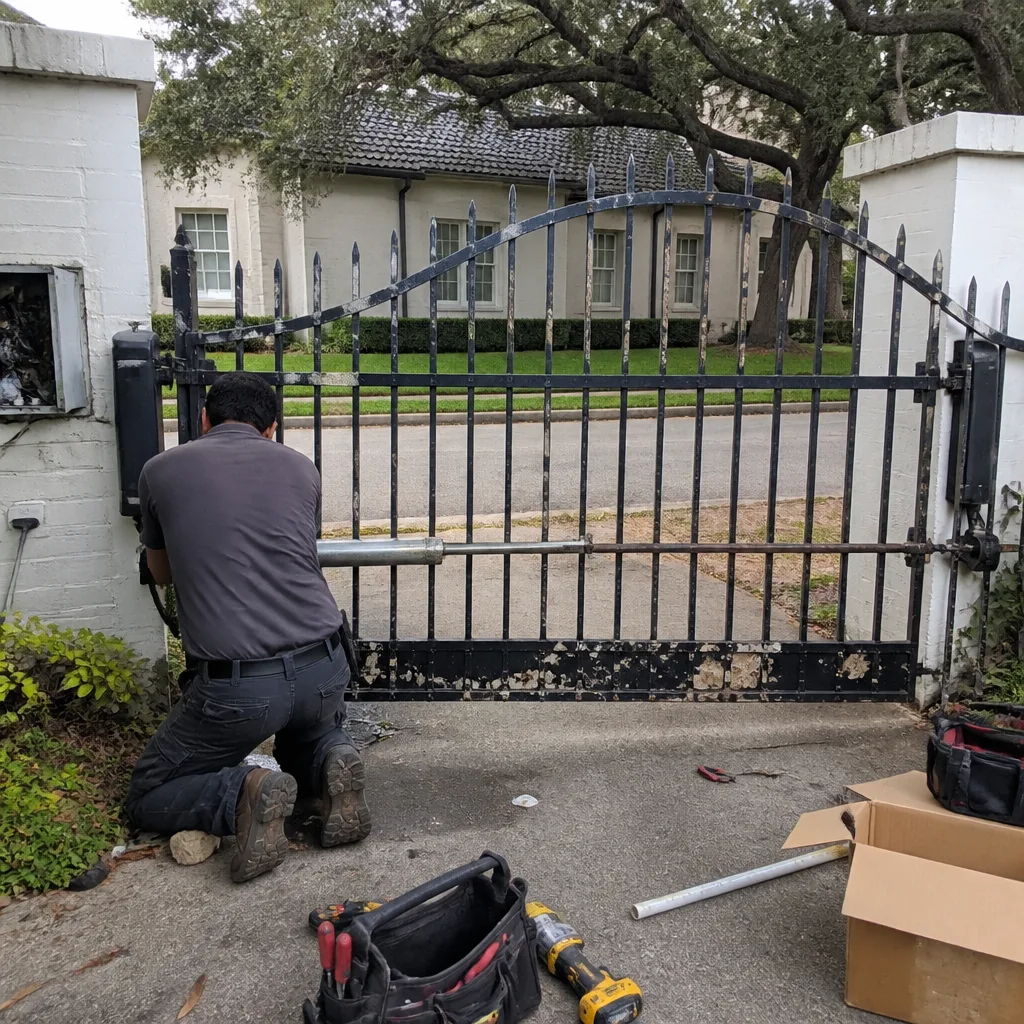 Before
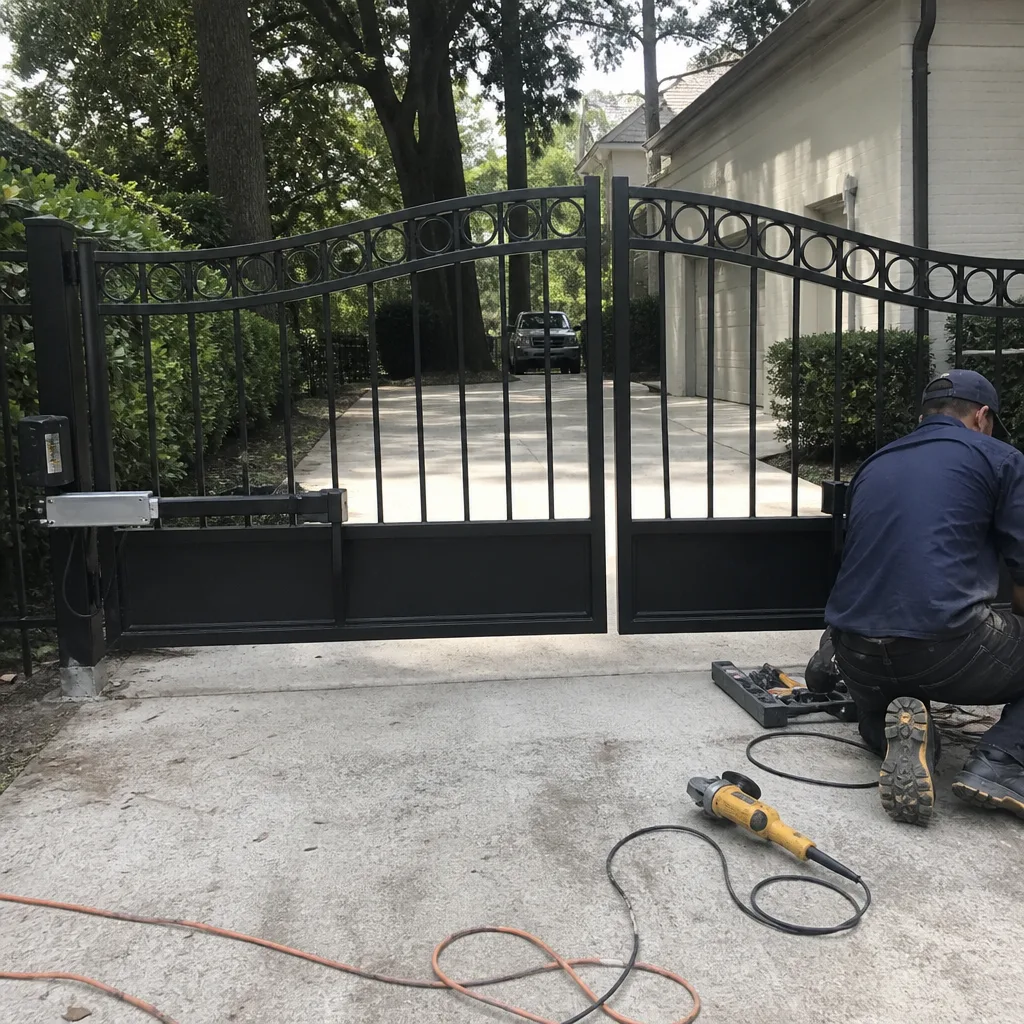 After
After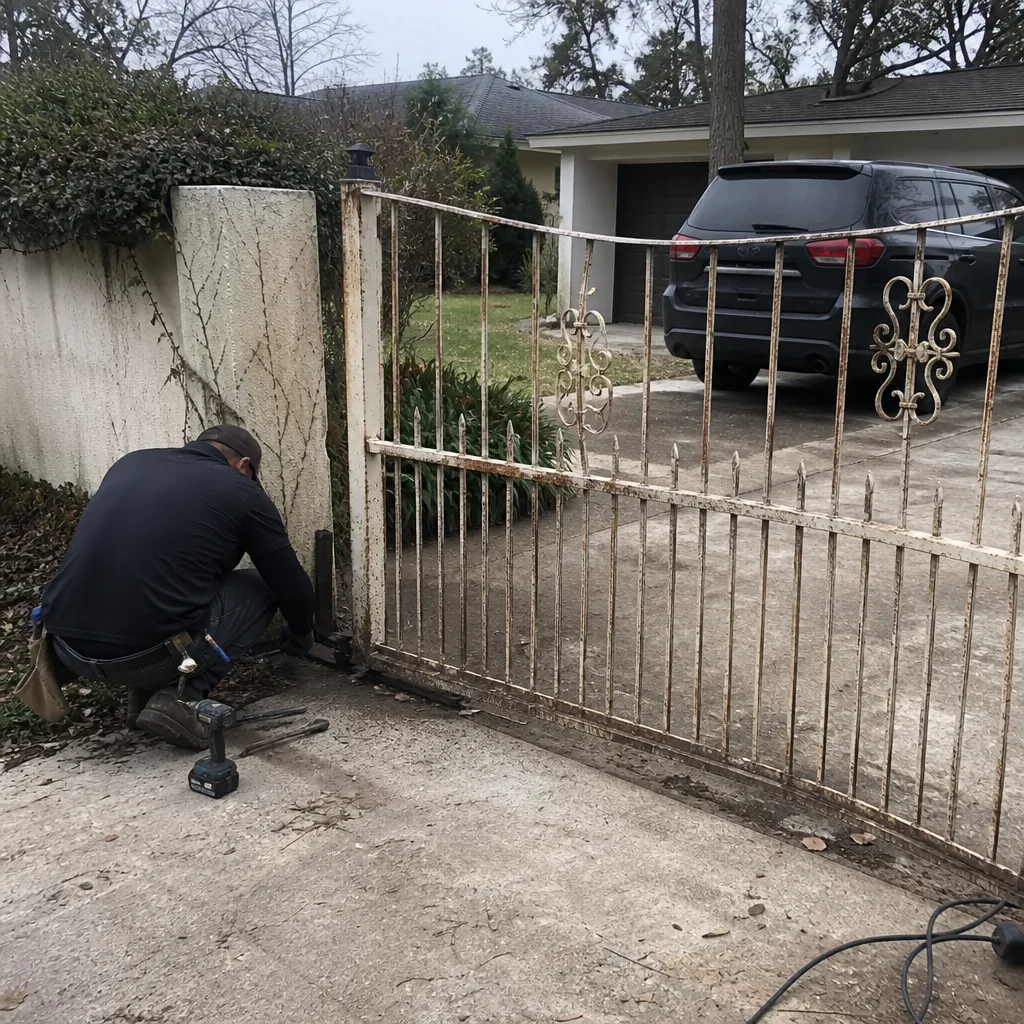 Before
 After
AfterGate Repair Warning Signs: A West University Place Homeowner’s Reference Guide
A gate that pauses mid-travel for half a second before continuing isn’t “almost working fine.” That hesitation is an overcurrent event being written to the operator’s control board, and in our experience across West University Place, it predicts a motor failure within 90 days more often than not. This guide teaches you to read the numbers your gate is already recording, identify the sounds that map to specific component failures, and document what you find so a Gate Repair services technician spends an hour diagnosing instead of three. We’ll cover operator error codes, measurement-based checks, audible signatures, and the failure log that cuts diagnostic time on every visit.
Quick Answer
The earliest gate repair warning signs in West University Place are rarely visual. They show up as half-second hesitations mid-travel, a gate that reverses randomly on cool mornings, an operator that runs hot to the touch after two cycles, an opener that resets its limits by itself, or a Vance Gate Repair West University Place documented log entry showing overcurrent faults stacking up in the control board. If you’re seeing any of these, the fix is usually under $400 if caught early, versus $900 to $2,200 if you wait for the failure to finish the job on its own schedule.
Table of Contents
- Reading Operator Error Codes: The Four Brands We See Most
- Intermittent Behavior: What Hesitation, Partial Travel, and Random Reversals Actually Mean
- The Sound-Based Diagnostic: Gear Wear vs. Binding vs. Capacitor Failure
- Why a Gate That Works “Most of the Time” Is the Most Expensive Gate
- How to Build a Failure Log That Cuts Diagnostic Time
- Measurements You Can Take Without Opening the Operator
- What These Repairs Cost in West University Place
- Common Mistakes to Avoid
- When to Call a Professional
- Frequently Asked Questions
BeforeAfterReading Operator Error Codes: The Four Brands We See Most
Every gate operator manufactured in the last fifteen years keeps a fault log. The board records overcurrent events, obstruction trips, limit resets, and power interruptions, then stores them as numbered codes. Most West University Place homeowners never see this log because nobody tells them it exists. Here’s how to read it on the four brands we work on most in this area: LiftMaster, FAAC, Elite, and Mighty Mule.
LiftMaster (models LA400, LA412, LA500, CSL24V): LiftMaster boards display codes on a small LED or a two-digit display. A code 31 means the gate hit an obstruction and reversed. A code 61 signals a thermal overload. The important one is code 84: intermittent RPM sensor failure. In West University Place, we see code 84 on units that sit in full afternoon sun, where the RPM sensor degrades from heat cycling. Homeowners ignore it because the gate still works, but the sensor is failing progressively, and when it goes, the operator refuses to move at all.
FAAC (models 400, 402, 422, 455D): FAAC boards use a programming display that shows codes like E1, E2, E5. E5 is the one that matters most for early detection: it indicates the torque limiter tripped because the gate encountered resistance above the set threshold. A single E5 on a cold December morning in West University Place often means a hinge is binding as the metal contracts. Repeated E5 entries on the same day mean the gearbox oil has thickened or the rack is misaligned. A homeowner who reads the E5 log can call for a hinge adjustment at $150 to $300 instead of a full gearbox replacement at $800 to $1,400.
Elite (models SL3000, MS2000, CSW200): Elite operators track cycle counts in the proprietary programming menu under “Diagnostics.” The board records total cycles, but it also records the last 10 fault events with timestamps. When an Elite board shows repeated “Overcurrent” entries, it means the motor is drawing more amperage than the board expects. That number is useful. A healthy Elite swing motor draws 3 to 5 amps during travel. At 7 to 8 amps, the gearbox is failing. At 10 to 11 amps, the motor windings are done. We document these readings on every visit because they tell us exactly how much life remains.
Mighty Mule (models MM360, MM500, MM600, FM200): Mighty Mule boards are consumer-grade but still log basics. The MM series flashes the status LED in patterns: three flashes then a pause indicates an obstruction, four flashes signals a stall. The stall code is your early warning in West University Place. Stall faults mean the motor tried to push and couldn’t, and Mighty Mule gearboxes are the component we replace most on these units, typically at the 4-to-6-year mark when the nylon gear strips. If your MM gate stalls once a week, the gear teeth are already wearing asymmetrically. You have about 30 days.
If you don’t know which brand you have, the operator housing always carries the name on the control board cover or the manual release plate. Photograph it. The photo belongs in your failure log, which we’ll cover below.
Intermittent Behavior: What Hesitation, Partial Travel, and Random Reversals Actually Mean
Intermittent behavior is the single most common warning sign we see on gate repair in West University Place, and it maps to specific components with surprising consistency. The key is to observe exactly what the gate does, when it does it, and under what conditions. That data narrows the diagnostic from a dozen possibilities to two or three.
Hesitation on start (half-second to two-second delay between command and movement): This means the start capacitor is losing its ability to provide the initial voltage spike. Start capacitors degrade with heat and age, and West University Place summers accelerate that process. A gate that hesitates on the first cycle of the day but moves normally afterward has a capacitor with a fading charge. Replace the capacitor now ($40 to $90 in parts, $180 to $320 installed) and the motor lives another five years. Ignore it and the motor starts against full load resistance, which burns windings and turns a $300 repair into a $1,200 motor replacement.
Partial travel with stop-and-start motion: The gate opens partway, stops for a second, then continues. In our experience this maps to one of three things: a failing limit switch, an obstruction in the track or chain path, or a control board that’s dropping its travel memory. The limit switch is the most common and the cheapest. A limit switch that’s wearing out sends intermittent stop signals to the board. Replace it, reset the limits, and the gate returns to smooth travel. A board that resets its limits by itself is a $350 to $600 problem.
Random reversals (gate starts closing, then reverses partway through): This is almost always a photo-eye misalignment or a failing safety edge. The photo-eye, that infrared beam mounted near the ground on each side of the gate opening, drifts out of alignment when the gate post shifts slightly. In West University Place, where clay soil expands and contracts with moisture, post shift is a real thing. The gate opens fine because the beam gets a clean signal, but as it closes, the changing angle blocks the beam and the board interprets that as an obstruction. A realignment takes twenty minutes. A failing safety edge, by contrast, sends false obstruction signals even when nothing is in the path. If your gate reverses and there’s no visible obstruction, log the time of day and the weather. Morning reversals after damp nights suggest post shift; afternoon reversals in dry heat suggest the safety edge’s internal contacts are degrading.
Gate travels further than it should (hits the open stop hard, or pushes past the close point): This means the limit setting is no longer being read correctly. On a LiftMaster, that’s a limit switch replacement. On a FAAC, it’s often a magnetic limit sensor that’s drifted. The gate banging into the hard stop stresses the chain, the rack, and the hinge welds. Each impact does incremental damage. A gate that slams into its open stop daily is slowly breaking its own mounting hardware.
The Sound-Based Diagnostic: Gear Wear vs. Binding vs. Capacitor Failure
Each failing component makes a distinct sound, and once you know what to listen for, you can identify most gate problems from the sidewalk. Here’s what each signature sounds like.
Worn gearbox: a rhythmic grind with a regular beat. The gear reduction inside the operator uses nylon or brass gears. When teeth start shearing or wearing unevenly, the gear makes a grinding sound that matches the speed of the gate. It’s rhythmic, regular, and sounds mechanical. As wear progresses, the rhythm gets louder and the pitch changes slightly. A gate grinding with the travel cycle, not with the wind, has a gearbox problem. Replacement runs $500 to $1,100 depending on brand, and it’s a repair we recommend before the gear fails catastrophically and locks the gate in place.
Binding hinge or track: a creak or squeal that’s irregular and tied to position. A binding hinge doesn’t sound like a gearbox. It’s intermittent, it changes with the position of the gate, and it often sounds like metal dragging on metal at a specific point in the arc. If the noise happens at the same gate position every time, it’s mechanical binding at a hinge or a wheel. Hinge bearing replacement runs $120 to $300. A wheel or roller replacement runs $180 to $400. Both are cheaper than a gearbox.
Failing capacitor: a brief hum with no movement, then a click. When the start capacitor is dead, the motor hums for a second but doesn’t turn, then the thermal overload clicks out. It’s a low, electrical hum, nothing like a grind. If you hear the hum and the gate doesn’t move, the capacitor is the first suspect. If you hear the hum and the gate starts eventually, the capacitor is fading and needs replacement now. We covered the cost above.
Motor bearing failure: a high-pitched whine at high speed. Motor bearings make a whine that rises in pitch as the motor spins up. It’s smoother than a gear grind and higher-pitched than a binding hinge. Bearing replacement is possible on some units but most homeowners replace the motor assembly, which runs $350 to $800 installed depending on brand and whether the arm bracket is reusable.
A quick note on documentation: any of these sounds is worth recording on your phone. A ten-second video with clear audio helps a technician identify the issue before ever arriving, and it becomes part of your failure log. We’re always glad to review a sound clip when a West University Place homeowner calls about a noisy gate, because half the time we can name the failing part from the audio alone.
Why a Gate That Works “Most of the Time” Is the Most Expensive Gate
This is the counterintuitive core of gate repair economics, and it’s worth understanding clearly. A gate that has stopped completely is a contained failure. The damage is done, the repair scope is obvious, and the quote reflects one job. A gate that works most of the time, but hesitates, reverses, or grinds occasionally, is a progressive failure. Each symptom is a component degrading, and every day it runs in that condition, it’s putting load on the components around it.
Here’s the sequence we see most often on West University Place swing gates: a hinge begins to bind, which increases the load on the operator, which causes the motor to draw more amperage, which heats the windings, which degrades the capacitor, which eventually fails and takes the control board with it when the voltage spike hits. At the start of that chain, the repair was a hinge bearing at $150. At the end, it’s a hinge, a capacitor, and a board at $800 to $1,500 plus labor.
The same logic applies to intermittent operator faults. A gate that trips its thermal overload once a month is running too hot. The cause might be a simple limit adjustment, a $120 fix. But every month that gate overheats, the insulation on the motor windings breaks down further. Once the windings fail, the motor is done, and you’re paying for a full replacement that could have been avoided with a limit adjustment months earlier.
We say this from direct experience, and our How to Hire a Gate Repair Contractor in West University Place: A Step-by-Step Guide covers what to look for: the most expensive gates we replace in West University Place are not the ones that broke suddenly. They’re the ones that warned their owners for six to twelve months, in codes and sounds and half-second hesitations, and nobody had the vocabulary to read the signs. That’s exactly what this guide aims to fix.
How to Build a Failure Log That Cuts Diagnostic Time
A failure log is simply a written record of what your gate did, when it did it, and under what conditions. It takes two minutes per entry, and it’s the single most valuable thing you can hand a technician. Here’s exactly how to structure it.
- Date and time. Write it down. Weekday vs. weekend matters less than you’d think. Time of day matters a lot because temperature and sun exposure affect gate behavior.
- What the gate did. Be specific. “Gate stopped halfway open” is better than “gate acting up.” “Gate reversed while closing at about 6 feet from closed” is the level of detail that names a component.
- What you were doing. Did you press the remote from 40 feet away, or from the keypad at 8 feet? Remote distance issues point to receiver problems. Keypad issues point to control board input problems.
- Weather at the time. Temperature, humidity, and recent rain. This data helps distinguish thermal issues from post-shift issues from electrical issues. In West University Place, the difference between “rained yesterday” and “dry for two weeks” explains a lot of intermittent gate behavior.
- What happened next. Did the gate recover on its own? Did you press the remote again and it worked? Did you have to use the manual release? This tells us whether the problem is intermittent, which narrows the diagnostic significantly.
- Any sounds. Hum, grind, click, squeal, or nothing. Attach the phone video if you recorded one.
After five entries, a pattern typically emerges. After ten entries, we can name the failing part from the log alone in most cases, which means the diagnostic portion of the visit takes thirty minutes instead of two hours. Every hour of diagnostic time you eliminate is money you don’t spend. It also means the written price we hand you reflects the actual repair, not a padded quote that assumes worst-case discovery. Under Clause 3 of the Haven Standard, we price against what the evidence shows, not against what we’ll find if we have to guess.
Measurements You Can Take Without Opening the Operator
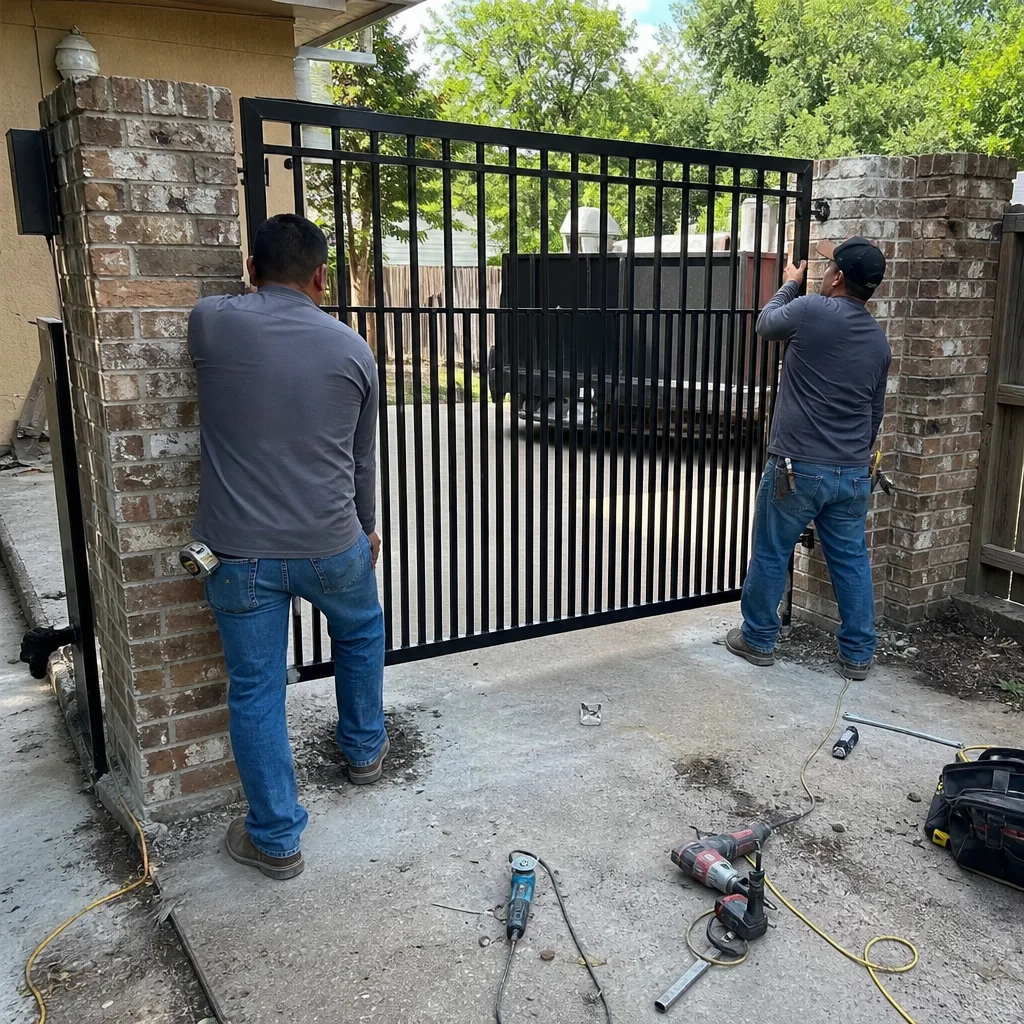
You don’t need to be a technician to gather useful diagnostic data. Three simple measurements will tell you a lot about your gate’s health, and all three can be taken with a tape measure and your phone’s stopwatch.
1. Travel time from fully open to fully closed. Time your gate’s full travel cycle. Most residential swing gates in West University Place take between 12 and 18 seconds per direction. If your gate’s travel time is getting longer, that’s a sign the operator is working harder, either from a binding hinge, low voltage, or a fading motor. A slower gate is a loaded gate. A sudden change in travel time of more than two seconds warrants a call.
2. Gap measurements at the hinge and latch points. Measure the gap between the gate leaf and the post at the hinge and at the latch when the gate is closed. Write the numbers down. Then measure the same gaps again in three months. Any change means the gate or the post is shifting, and in West University Place’s clay soil, that shift is normal but needs correction. A quarter inch of post movement is enough to misalign a photo-eye and cause random reversals.
3. Voltage at the operator, if you’re comfortable using a multimeter. This measurement requires removing a cover, and if you’re not comfortable working around electrical connections, skip it. But if you are, the operator’s input voltage should read within 10% of 115 volts on a standard residential circuit. West University Place homes on older service sometimes see voltage drop when the air conditioner cycles on, and that voltage drop can cause an operator to stall or reverse. A reading of 104 volts or lower during peak afternoon hours points to an electrical supply issue, not a gate component failure, and the fix might be an electrician’s job rather than a Seasonal Gate Repair Care for West University Place: Year-Round Homeowner’s Guide issue.
Record all three measurements in your failure log. A technician who arrives to find a documented baseline and a documented change is arriving with half the diagnostic already done.
What These Repairs Cost in West University Place
Pricing transparency is the entire point of the Haven Standard, and this guide would be incomplete without real numbers. The ranges below reflect what we see across West University Place in 2025 and into 2026: parts prices have stabilized somewhat after the 2021-2023 supply shocks, but labor remains steady at about $115 to $150 per hour for licensed gate work in this market.
- Photo-eye realignment: $90 to $180, done on site in under an hour.
- Hinge bearing replacement (per hinge): $120 to $300 depending on gate weight and hinge type.
- Capacitor replacement: $180 to $320 installed.
- Limit switch replacement and reset: $150 to $350 depending on brand.
- Gearbox replacement: $500 to $1,100 depending on brand and whether it’s a swing or slide operator.
- Control board replacement: $350 to $700 for most residential boards.
- Motor replacement: $350 to $800 for most swing operators, $600 to $1,400 for slide operators.
- Full operator replacement (motor, board, arm): $1,200 to $2,600 most units, installed and programmed, brand dependent.
Every one of these repairs gets a written price before work begins, and the written price is the price you pay unless we find something that requires a changed scope, in which case we stop, explain it, and get your sign-off before picking up a tool. No West University Place homeowner we work with ever gets a surprise invoice at the end of a job. That’s Haven Standard Clause 1, and we’ve never operated any other way since Adrian Vance started this company in 2014.
Common Mistakes to Avoid
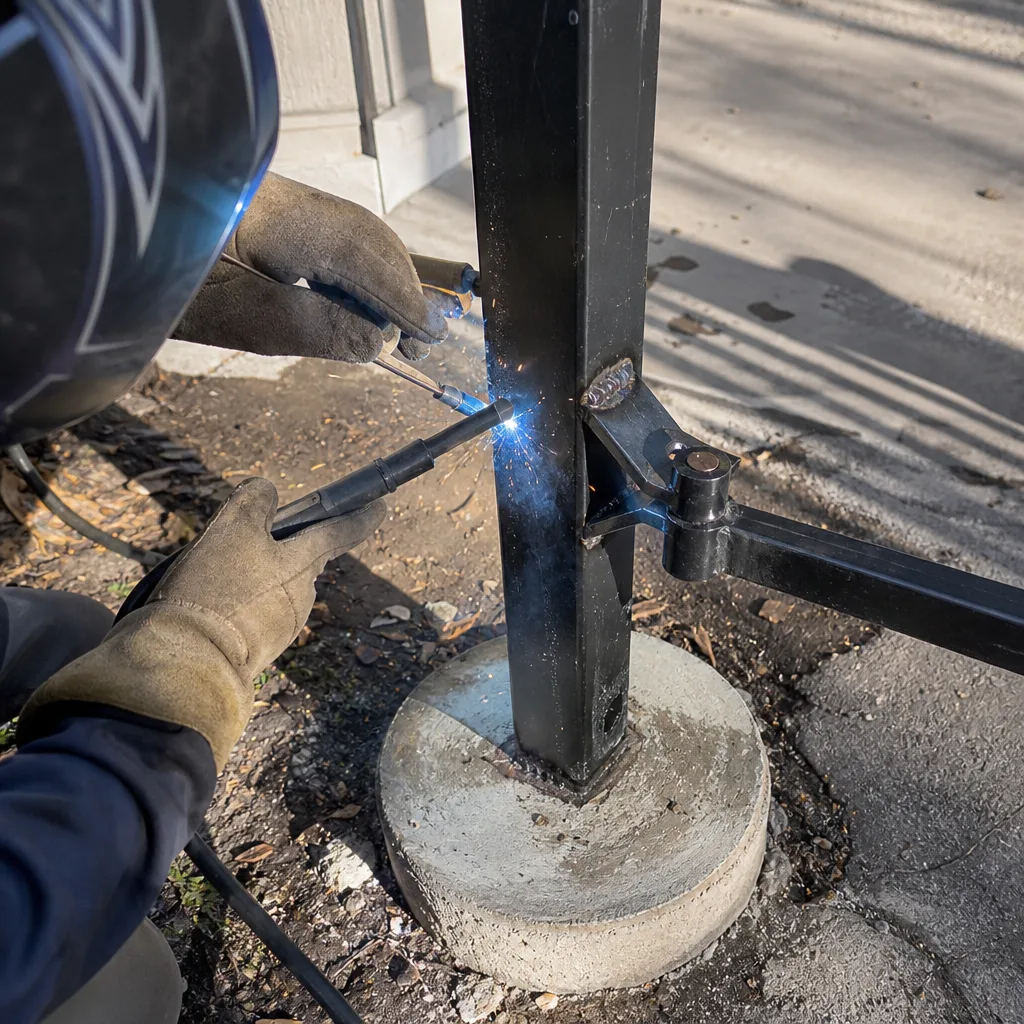
- Ignoring the operator’s fault log because “the gate still works.” The log is the earliest warning system you have. Overcurrent faults don’t appear when the gate fails; they appear for months before the failure, and reading them is the difference between a $150 repair and a $1,200 replacement.
- Lubricating a binding hinge instead of replacing the bearing. Grease masks a bearing failure temporarily, but the wear continues underneath. In West University Place’s summer heat, the grease thins and runs out within weeks, and the bearing fails anyway, only now the operator has been running loaded for two extra months.
- Replacing the remote battery when the real problem is the receiver board. A fading remote signal has multiple causes. If you’ve replaced the battery twice and the range is still shrinking, the receiver or the antenna connection is the issue. A new battery fixes nothing and delays the actual repair.
- Waiting for the gate to stop completely before calling. This is the exact opposite of what the gate’s warning signs are telling you. A gate that gives you codes, sounds, and hesitations for six months is asking for a small repair that becomes a large one if ignored.
- Using a generic handyman for automated gate repair. Gate automation is a specialty. A handyman can often fix a mechanical hinge issue, but when the problem involves limit switches, fault logs, torque settings, and safety-edge resistance calibrations, a generalist without gate-specific training can make the problem worse, and we’ve repaired gates in West University Place that were “fixed” by someone who adjusted a limit switch without understanding what the board was reading.
- Not documenting the issue before the technician arrives. “It doesn’t work sometimes” is the phrase that produces the longest, most expensive diagnostics. “On June 12 at 4:30 PM, in 93-degree weather, the gate reversed at the halfway point and recovered on the third remote press” is the phrase that cuts diagnostic time by an hour.
- Buying a whole new gate when the operator is the failing component. Gate replacement is sometimes the right call, but a failing operator doesn’t mean the gate itself is done. We regularly repair or replace operators on gates that have twenty years of life left in the structure. Gate installation in West University Place is a service we offer when the structure genuinely needs replacement, but we’ll tell you plainly when a $600 operator swap fixes the whole problem.
When to Call a Professional
Call when the gate hesitates, when the fault log shows repeated overcurrent events, when the travel time changes, when you hear a grind that tracks with gate movement, when the gate reverses with no obstruction present, or when the operator housing is hot to the touch after two normal cycles. For more guides & resources, see our blog. None of these require emergency response, but all of them should be scheduled within a week or two. The exception is any situation where the gate is stuck in the open position and cannot be secured, or where the gate has come off its track and poses a fall hazard. Those warrant a same-day response. Vance Gate Repair West University Place offers free estimates in West University Place, and a live person answers the phone 24 hours a day at (346) 375-5416.
Frequently Asked Questions
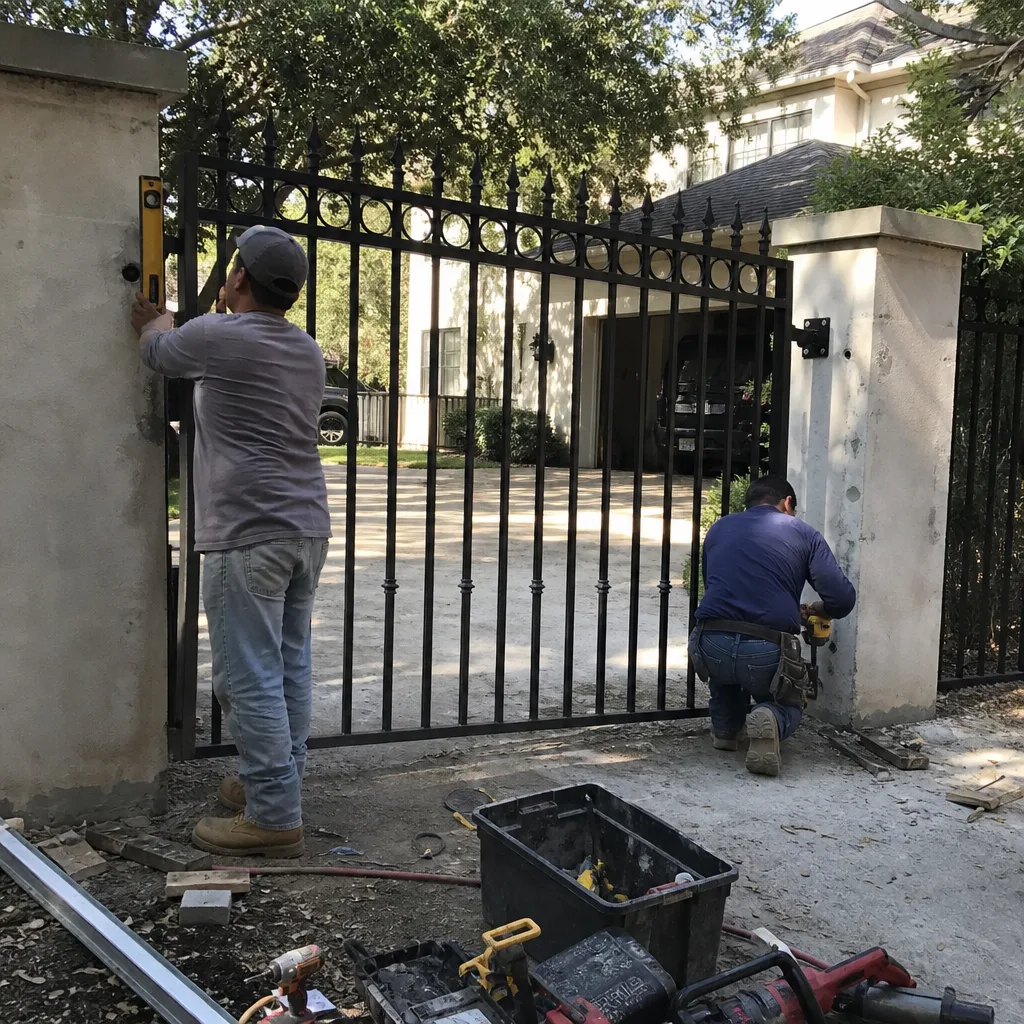
Every modern operator logs faults internally, and you can access the log through the small display or LED on the control board, depending on brand. LiftMaster, FAAC, Elite, and Mighty Mule all store fault history in the board’s memory, and a technician can pull that history in under five minutes. If you’re not comfortable opening the operator housing, call us and we’ll read the log as part of a free estimate.
A half-second hesitation between command and movement most often indicates a fading start capacitor, though it can also be a low-voltage condition. It’s an early warning that the motor is starting under load, which degrades windings over time. Replacement is inexpensive, so the hesitation is worth addressing the week you notice it.
You can, but it’ll cost you more. A gate that works intermittently is a gate with a failing component that’s loading the components around it. The longer it runs in that condition, the more damage accumulates. A hinge bearing fix at $150 to $300 becomes a gearbox replacement at $500 to $1,100 once the binding has loaded the operator for six months.
Unexplained reversals are almost always a photo-eye alignment issue or a degrading safety edge. In West University Place, clay soil expansion and contraction shifts gate posts enough to misalign photo-eyes, and the gate interprets the beam interruption as an obstruction. A realignment or safety edge replacement resolves it, and both are relatively inexpensive.
Most swing-gate motor replacements run between $350 and $800 installed, depending on the brand and whether the arm bracket and linkage are reusable. Slide-gate motors run higher, between $600 and $1,400. The written price you get before work starts is the price you pay, and it includes the programming and limit setting. Call (346) 375-5416 for a free estimate on your specific unit.
If your gate is stuck open and won’t respond to the remote or the keypad, the manual release will let you move it by hand in most cases so you can secure the property. The manual release is typically a red handle or a keyed lock on the operator housing. If you can’t get it closed manually, or the gate is too heavy to move safely, call us at (346) 375-5416. A live person answers around the clock, and we can dispatch a technician to West University Place the same day.
The Bottom Line
Your gate is already telling you what’s wrong. The operator’s fault log records overcurrent events before you ever see a problem. The sounds it makes map to specific components, each with a distinct signature. The half-second hesitations and unexplained reversals are not quirks; they’re data points that, read together, predict failures weeks or months in advance. The homeowner who learns to read those numbers, document them in a simple failure log, and call when the pattern emerges is the homeowner who spends $150 instead of $1,500. For everything else, gate motor and opener service in West University Place is what we do every day, and we’re glad to read the log with you and give you a written price before any works begins.
Written by Adrian Vance, Owner at Vance Gate Repair West University Place, serving West University Place since 2014.