
Last updated September 20, 2026
Free on-site gate assessment - hinges, posts, and your LiftMaster or Nice gate operator checked before anything is quoted
The assessment is free and the quote is the invoice.


 Before
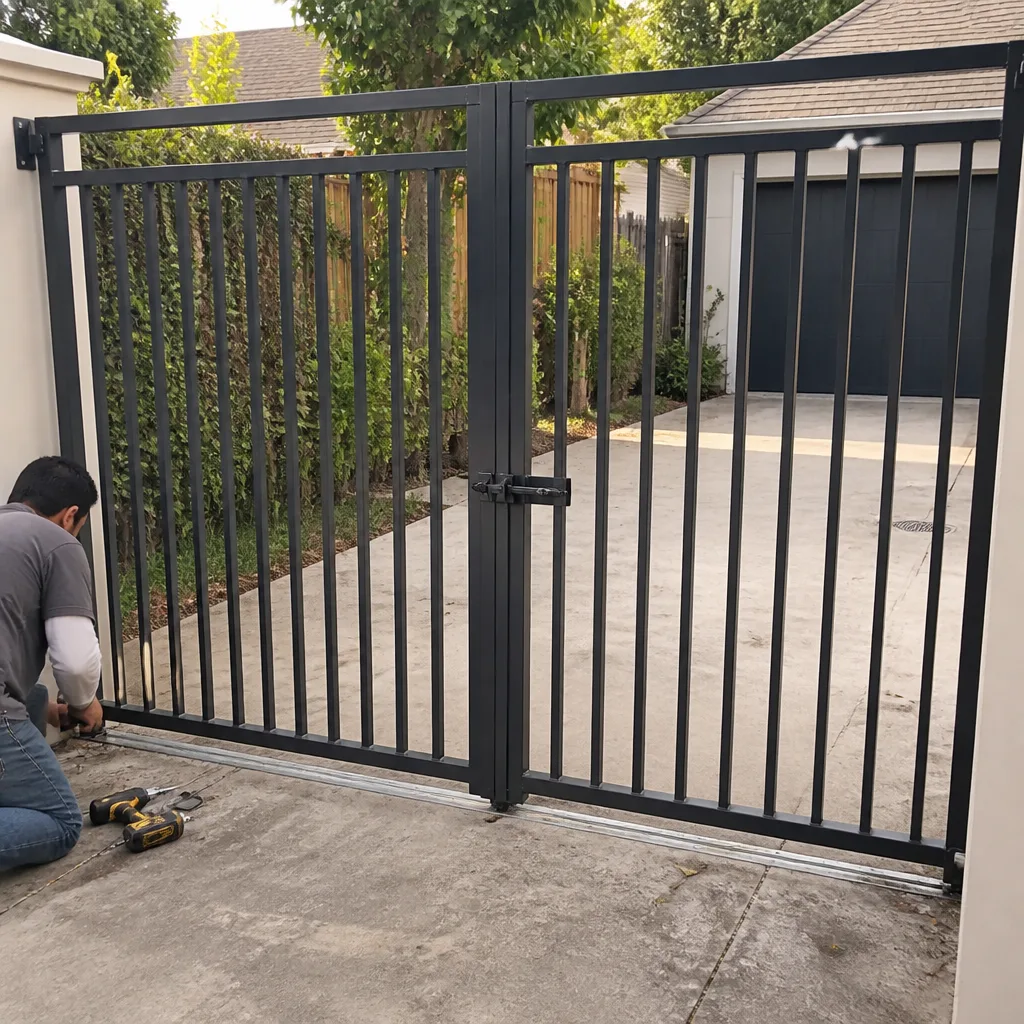 After
After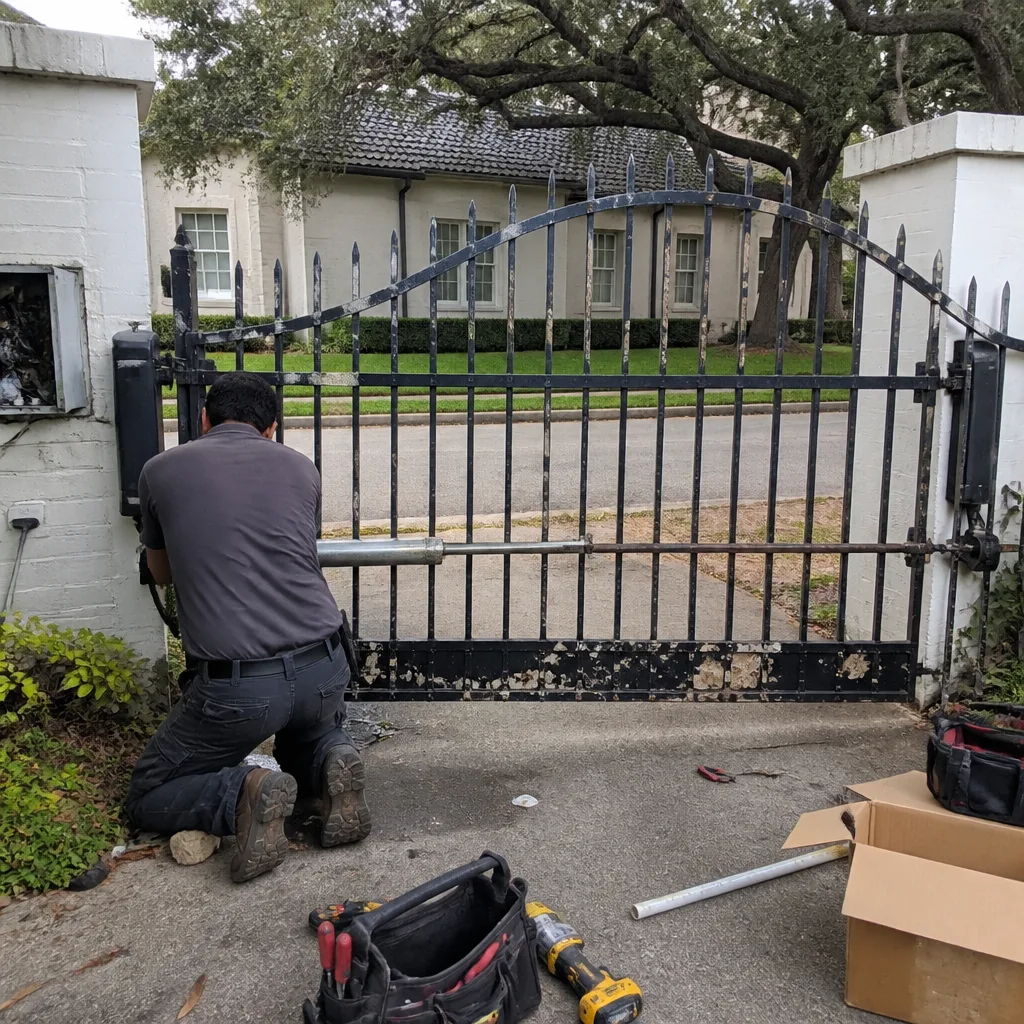 Before
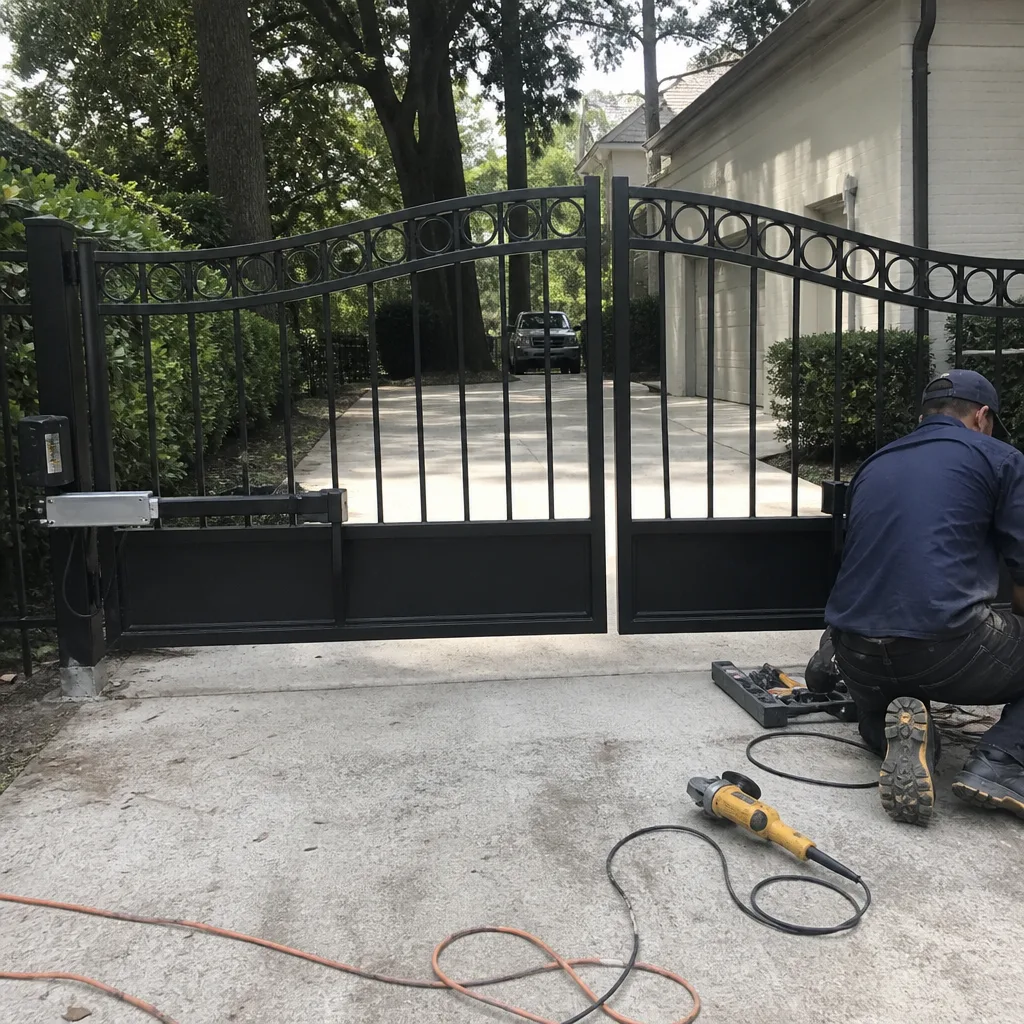 After
After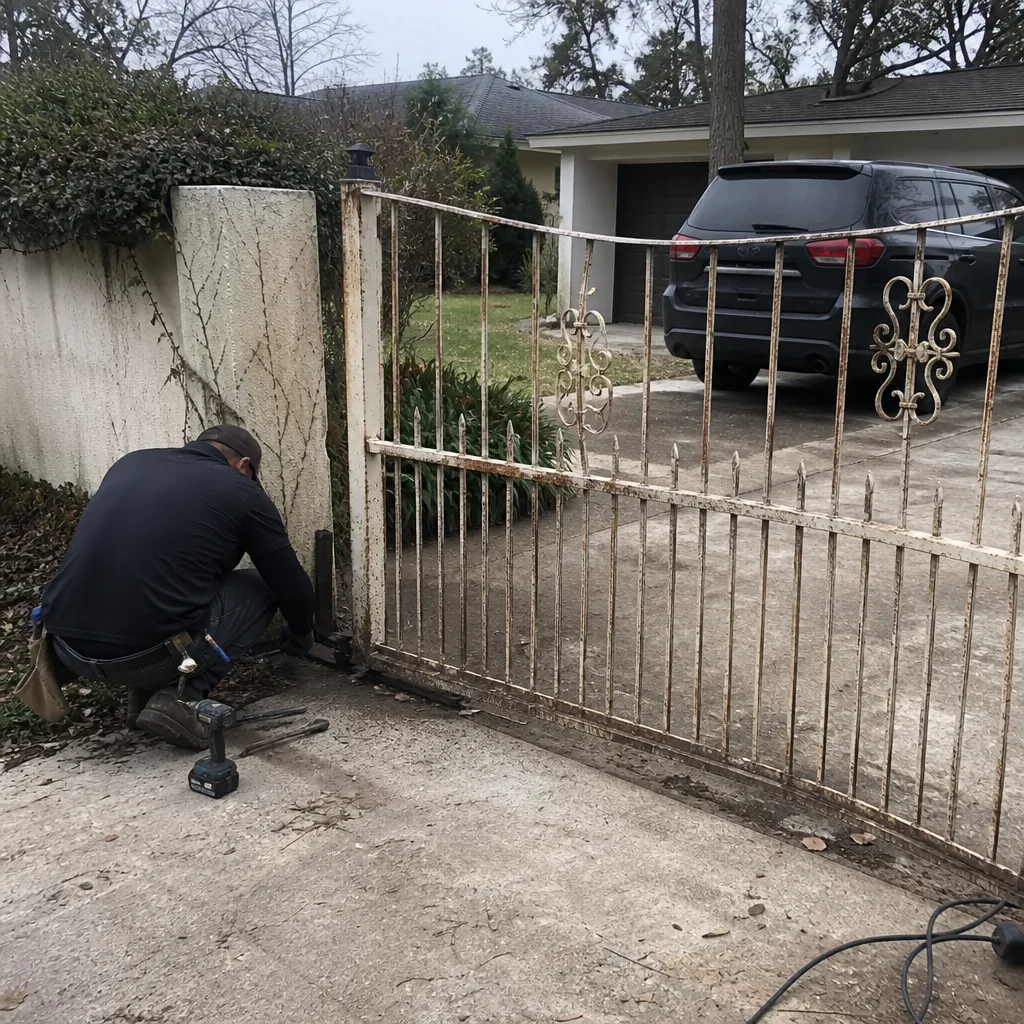 Before
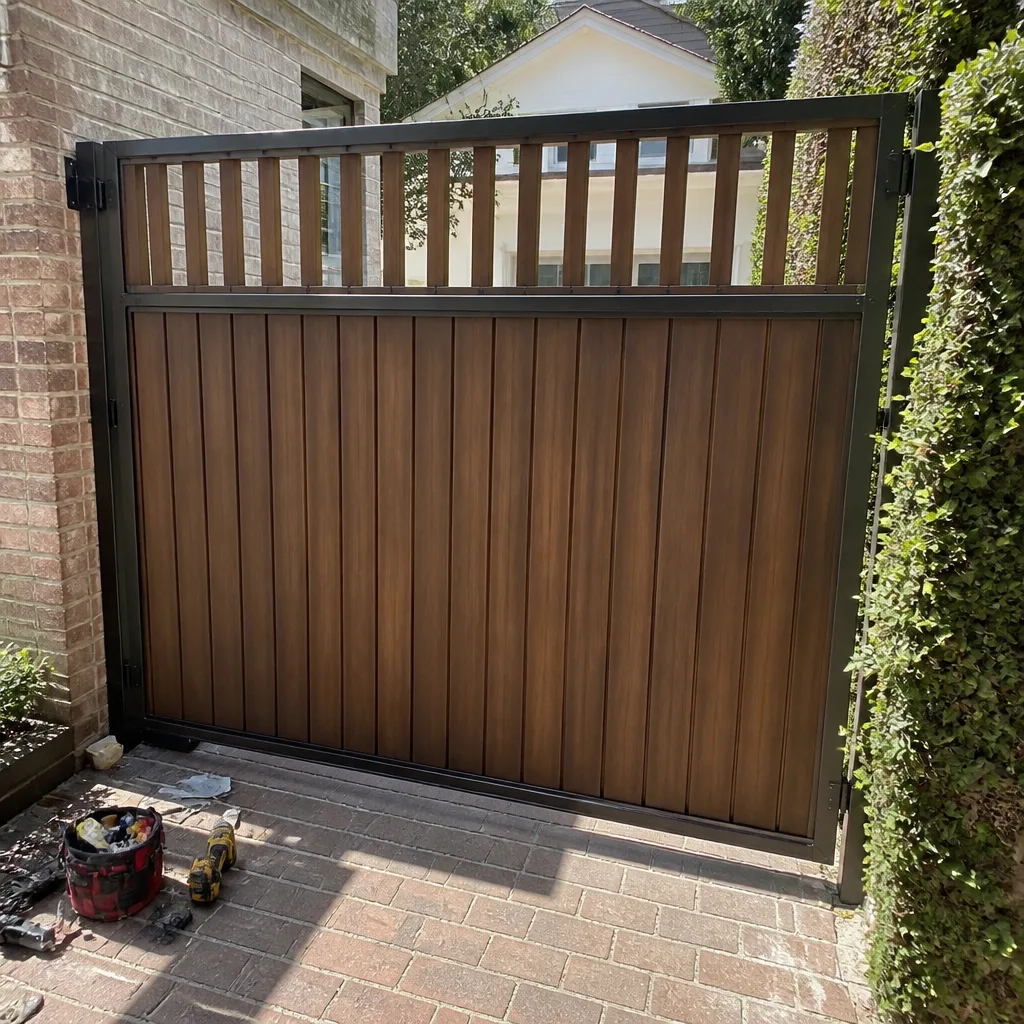 After
AfterHow to Hire a Gate Repair Contractor in West University Place: A Step-by-Step Guide
In West University Place, a driveway gate that won’t close isn’t an inconvenience you can sit on. The houses are close together, the alleys are narrow, and an open gate is an invitation to every porch pirate within three blocks. What separates a good hiring decision from a costly one isn’t whether you choose the cheapest quote. It’s whether the contractor hands you a written scope before anyone touches a tool. This guide walks you through the exact hiring process we’d recommend to a neighbor, with the line items, licensing checks, and documentation requirements most gate repair contractors hope you never ask about.
Quick Answer
To hire a gate repair contractor in West University Place, get a written scope that lists part numbers, labor hours, and the exact conditions that trigger a change order, then verify the contractor carries the low-voltage electrical licensing Texas requires for gate automation work, and demand a documented photo record at job completion. Skip any contractor who won’t put the price in writing before work starts. That single filter eliminates most of the bad actors in the West University Place gate repair market before you’ve spent a dime.
Table of Contents
- Why the Written Scope Is Your Primary Hiring Filter
- The Line Items a Binding Written Scope Must Contain
- How to Verify Low-Voltage Electrical Licensing in Texas
- Red Flags Specific to Gate Repair Quotes
- Questions to Ask Before Any Work Begins
- What Documentation to Request at Job Completion
- How to Structure a Callback Clause in Writing
- Common Mistakes to Avoid
- When to Call a Professional
- Frequently Asked Questions
- The Bottom Line
Why the Written Scope Is Your Primary Hiring Filter
A gate contractor who won’t produce a written scope before touching your gate isn’t cutting a corner. They’re structurally protecting themselves from accountability, and the cost lands entirely on you. We’ve heard the stories from homeowners across West University Place: the verbal quote of $400 that became an invoice for $1,100 because “the arm bracket was worse than expected.” The truth is, that bracket was visible the moment the technician opened the motor housing. A competent contractor sees it, names it, and prices it before work begins.
Most gate repair in West University Place follows a predictable pattern. The failure mechanism is rarely a mystery. Springs fatigue. Limit switches drift. Photo-eyes get knocked out of alignment. A technician who has repaired thousands of gates knows the failure modes by heart. So when a contractor says “we won’t know until we open it up,” what they’re really saying is “I want the power to set the price after you’re committed.” That’s the structural protection we’re talking about.
The written scope is the fix. It doesn’t have to be formal. It needs to be specific. “Replace swing-gate motor, part #LiftMaster LA400, 2 hours labor, $X.” If the actual repair takes three hours, that’s the contractor’s problem, not yours. If a part is genuinely more expensive than expected, the change order clause handles it, and that clause needs to be in writing too. The whole point of hiring in writing is that both parties agree on what “done” means before the work starts.
The Line Items a Binding Written Scope Must Contain
We focus on gate motor and opener repair throughout West University Place, and in our experience, a written scope that’s worth the paper it’s printed on contains at least seven distinct line items. If any of these are missing, the scope is a suggestion, not a contract. Here’s what to look for:
- Exact part numbers. Not “a new motor.” The manufacturer and model number. A LiftMaster LA400 is $X. A generic aftermarket equivalent is less. The scope must say which one you’re buying.
- Labor hours, stated explicitly. If the contractor quotes 2 hours and uses 5, the scope should specify that any labor beyond the stated hours triggers a change order. Without that sentence, you’re paying for their misjudgment.
- The trigger conditions for a change order. “If the gate post is found to be cracked, additional charges will apply after photographic documentation is provided.” That’s a legitimate change order. “If we find unexpected issues, we’ll adjust the price” is not.
- Disposal fees for the removed parts. Gate motors and steel arms don’t go in the trash. If the contractor is hauling scrap, the scope should say whether that’s included or extra.
- Warranty terms in months, not adjectives. “One year parts and labor” is concrete. “Fully guaranteed” is not. Get the duration and what it covers.
- What the contractor leaves behind. The old parts? The wiring diagram? A photo record? Specify it in the scope. We’ll cover documentation in a later section, but it belongs in the written agreement.
- The total price, including tax. Not an estimate of the total. The total. In writing. Signed or at least confirmed by email before the first tool comes out.
This may sound like a lot to ask. It’s not. It’s a standard commercial access-control work order, the kind Adrian Vance wrote thousands of on commercial sites before founding Vance Gate Repair in 2014. For more on gate repair in West University Place, see our complete guide. Commercial property managers have always demanded this level of specificity. Residential homeowners in West University Place deserve the same. The Haven Standard, the documentation protocol Vance follows on every job, exists because residential customers were getting verbal quotes and handwritten invoices with three vague line items. Clause 1 of that standard is simple: have it in writing. Every job. Every time.
How to Verify Low-Voltage Electrical Licensing in Texas
Here’s a fact most West University Place homeowners don’t know until it’s too late: in Texas, installing or servicing automated gate systems requires a low-voltage electrical license from the Texas Department of Licensing and Regulation. Gate motors run on low-voltage circuits, and the connection between the motor, the control board, and the power supply falls under TDLR jurisdiction. An unlicensed handyman can replace a hinge. He cannot legally wire a gate motor.
This matters for three reasons. First, insurance. If an unlicensed contractor damages your property or injures himself on your property, your homeowner’s insurance may deny the claim because you hired an unlicensed vendor for licensed work. Second, code compliance. West University Place enforces building codes, and gate automation falls under them. A unlicensed installation can surface during a home inspection when you sell. Third, safety. Gate automation involves sensors, force settings, and circuit logic. Done wrong, a gate motor can crush a child, a pet, or a car door. The low-voltage license isn’t paperwork theater. It’s proof that someone has been trained to set the entrapment protection correctly.
Verification is straightforward. Go to the TDLR license search portal, enter the company name, and confirm the license is active and the class covers electrical work. If the contractor hesitates to provide their license number, that’s the end of the conversation. A licensed contractor is proud of the number. They’ll put it on the estimate. At Vance Gate Repair, the license number appears on the page, and the technician’s name and photo are sent to the customer before arrival. That’s not special treatment. That’s baseline professionalism for licensed work in Texas.
Red Flags Specific to Gate Repair Quotes
Every industry has its patterns, and gate repair has one that’s so common in West University Place we can describe it from memory. The call starts with “we’re in the area fixing another gate, so the diagnostic fee is waived if you book today.” That sounds like a favor. It’s a structural incentive to misdiagnose.
Here’s why the “diagnostic fee waived” structure is dangerous. A contractor who charges a flat diagnostic fee, regardless of whether you book the repair, has no financial pressure to find a problem. A contractor who only gets paid if you book has every incentive to tell you the gate needs a new motor when all it needs is a limit switch adjustment. The difference is $900. And if the diagnosis is wrong, the contractor isn’t going to come back and say “turns out the motor was fine.” They’ll install the new motor, and your original problem might disappear because the new motor comes with a properly set limit switch. You paid $1,200 for a $150 adjustment. The “waived” diagnostic fee cost you $1,050.
Other red flags specific to this trade:
- “We only service [one brand].” Gate motors made by BFT and Linear and Viking all fail in predictable ways that any trained technician can diagnose. A brand-exclusive contractor will steer you toward replacing your working Ghost Controls opener with their preferred brand, not because it’s necessary but because it’s their margin.
- “The whole gate needs to be replaced.” Sometimes true. Rarely true on a gate less than 15 years old. Steel posts rust through in Houston’s humidity, and we’ve seen genuine replacement cases in West University Place where the post was corroded at the base. But if the contractor can’t show you a photo of the specific failure, get a second opinion.
- “We don’t provide written breakdowns, but I’ll write it on the invoice.” This is a verbal quote with extra steps. The invoice comes after the work. The invoice is not the scope. These are different documents serving different purposes.
- “The price depends on what we find.” That sentence means the contractor hasn’t seen the gate and intends to price it after you’re committed. No licensed, experienced technician needs to “see what we find” to quote a gate motor replacement. The failure modes are standardized. The parts are standardized. The labor is standardized.
When we quote a gate repair in West University Place, the written price is handed over before any work starts. Not an estimate. A price. If the actual repair requires more work than the scope described, there’s a documented change order process. The customer sees the photo of the cracked weld before agreeing to the additional line item. That’s Haven Standard Clause 1, and it’s how every quote should work, from any contractor.
Questions to Ask Before Any Work Begins
The hiring conversation should feel like an interview, not a sales call. You’re the one asking the questions. Here’s the short list we recommend every West University Place homeowner run through before signing anything:
- “What’s your TDLR license number, and can I verify it online?” This single question filters out the unlicensed operators in about five seconds. If they hesitate, stammer, or say “we’re registered with the state,” walk away. Registered is not licensed.
- “Will you put the total price in writing before any work starts?” The answer must be yes. Not “we can give you a rough idea.” A written price. Before tools. Before parts. Before the technician opens the motor housing.
- “What happens if the repair takes longer than you quoted?” The correct answer is “the price doesn’t change unless we both agree to a change order in writing.” The wrong answer is “we’ll figure it out.” Figure-it-out pricing is how $400 quotes become $1,100 invoices.
- “Do you service my current brand, or do I need to replace it?” Vance services nine major automation brands, including BFT, Linear, Viking, and Ghost Controls, because the right answer to this question is “we service whatever’s on the property.” A contractor who only works on one brand is selling you a replacement, not a repair.
- “What documentation will I receive when the job is done?” See the section below. But the answer should include photos, part numbers, and settings documentation. If the contractor says “a receipt,” you’re not hiring a documentation practice. You’re hiring a handshake.
These questions don’t make you difficult. They make you a serious customer. The contractors who welcome them are the ones you want. The ones who get defensive are the ones who’ve been getting away with verbal quotes for years.
What Documentation to Request at Job Completion
Documentation is where most residential gate repair in West University Place falls short. The technician fixes the gate, hands over an invoice with a total and maybe a handwritten “new motor installed,” and leaves. Six months later the gate fails again, and the next technician has no idea what was replaced, what brand it was, or how it was configured. So the new technician starts from scratch, and you pay for the diagnostic all over again.
The fix is to demand documentation at job completion. Specifically:
- Photos of the work done. The damaged part before removal. The new part installed. The final configuration. These photos take two minutes to take and have real dollar value.
- Wiring diagram or annotated photo of the control board connections. If the motor was rewired or the board was replaced, the next technician needs to see how it’s connected. “The photo-eye wires were reversed” is something you only want to discover once.
- Settings printout or handwritten record. Gate motors have programmable settings: force limits, auto-close delay, entrapment sensitivity. If the technician adjusted these, the new values should be recorded. Otherwise the next repair starts with guessing what was changed.
- Part numbers for everything installed. Not “new control board.” The actual board model. Manufacturer, model number, maybe a serial. This is the line item we discussed in the formal scope section, and it belongs in the final documentation too.
- Warranty start date and terms. The warranty clock starts the day the work is completed, not the day you call about a problem. The documentation should state the date and the coverage period.
This documentation habit has real resale value. When you sell your West University Place home, a buyer’s inspector will look at the gate. A folder with the wiring diagram, the motor model, and a photo log of every repair tells the buyer that the house was maintained by someone who kept records. That’s a signal of overall property care. It’s not the reason you’ll sell the house, but it’s the difference between “the gate works” and “here’s the complete maintenance history.”
Vance’s commercial roots show here. Adrian Vance spent years writing documentation on commercial access-control sites, where the building manager demands a record of every adjustment. Vance brought that habit to residential Gates under what we call Haven Standard Clause 4: Evidence on every job. Every visit ends with a photo log and a written record of what was found, what was set, and what was installed. It’s not an upsell. It’s not an option. It’s the baseline.
How to Structure a Callback Clause in Writing
Warranty disputes become he-said-she-said because no one wrote down the callback terms before the work started. The technician says “I fixed the gate, the homeowner must have broken it.” The homeowner says “the gate never worked right after the repair.” Without a written callback clause, it’s two people’s memories, and memory favors whoever has the invoice.
A callback clause belongs in the written scope. It’s three sentences:
“If the repaired component fails within [term] of the repair date, [contractor] will return to diagnose and repair at no charge. A callback request must be made by phone or email and is not subject to dispute. This clause does not cover damage caused by collision, weather event, or third-party modification.”
That’s it. Write it, or ask the contractor to add it. The specific term is negotiable. Vance’s 365-Day Done Right Promise covers every repair for a full year, but any written callback term is better than a verbal promise. The point is that the callback obligation is in writing, with a defined duration and a defined trigger. When the gate fails again two months later, you’re not calling to negotiate. You’re calling to exercise a written term. That’s a different conversation.
The callback clause also protects the contractor. A clearly defined exclusion list means the contractor isn’t on the hook for a gate that got hit by a delivery truck or a teenager learning to reverse. The clause is a two-way street, and that’s why good contractors are happy to include it. They want the dispute resolved in writing, not in a review war three months later.
Common Mistakes to Avoid
- Hiring the first contractor who answers the phone. Availability is not competence. A contractor with a full schedule for two weeks probably has a full schedule because their work holds up. West University Place has a dozen gate repair options. Call three.
- Accepting a verbal quote as a contract. Under Texas law, verbal contracts exist, but they’re worthless in practice when the invoice is $700 higher than the quote. Get it in writing. That’s the entire thesis of this guide.
- Waiving the diagnostic fee in exchange for booking. As discussed above, this structure incentivizes the contractor to find a problem that requires a repair. Pay the diagnostic fee. Keep the incentive clean.
- Deciding “the gate is old, we should just replace it.” Old gates fail in documented ways. Steel posts corrode. Hinges wear. But in West University Place, where homes are maintained to a high standard, many gates have decades of life left in the right hands. Get a gate installation quote in West University Place only after a repair professional has confirmed replacement is actually necessary.
- Skipping the licensing verification because “the company seemed professional.” A clean truck and a polo shirt are not a license. The TDLR lookup takes two minutes. If you don’t check, you’re betting your insurance coverage on a marketing impression.
- Not requesting documentation at job completion. The gate works today. What about next year, when a different technician opens the motor housing and sees wires he doesn’t recognize? The documentation you request today is the money you don’t spend rediscovering the problem tomorrow.
- Treating the lowest price as the safest choice. The cheapest quote in West University Place is often a contractor who plans to name the real price after the work starts. The written scope prevents that. The price without the scope is just a number.
When to Call a Professional
You don’t need a professional to tell you your gate is stuck. You need a professional when the gate is stuck and you’ve confirmed the issue is electrical or mechanical, not obstruction. A photo-eye that’s been knocked by the lawn crew? You can see that. A gate that opens randomly at 3 a.m., a motor that hums but won’t turn, a gate that closes too hard and bounces back, a keypad that works intermittently? Those are control board, limit switch, or wiring problems. They require a licensed technician with diagnostic equipment.
If the gate is behaving like something inside is broken, it probably is. Don’t guess. Vance Gate Repair West University Place offers free estimates in West University Place. Call (346) 375-5416 and a live person answers, 24/7, not a voicemail loop. We’ll put the price in writing before any work starts, and we’ll leave you with a documented photo record when the job is done.
Frequently Asked Questions
Most gate repairs in West University Place fall between $180 and $850 depending on the failure. A photo-eye replacement runs $180 to $350. A limit switch adjustment is $150 to $250. A full gate motor replacement typically runs $850 to $1,800, depending on the brand and whether the arm bracket is intact. Part numbers and labor hours should be itemized in a written scope before any work starts. Call (346) 375-5416 for an exact quote on your specific gate, free and in writing.
Most repair work in West University Place can be scheduled same-day or next-day, especially if the gate is stuck open or closed and the property is unsecured. Vance Gate Repair has a live person answering the phone 24/7, so you’ll know within minutes whether a technician can be dispatched today. Call (346) 375-5416 and describe what the gate is doing. The dispatcher will tell you when someone can arrive.
Simple repairs like motor replacement, hinge replacement, or limit switch adjustment typically don’t require a permit. New gate installations that involve structural changes to posts or foundation work may require permitting through the city. A licensed contractor will tell you if your project falls into the permitting category. The key is to work with someone who knows West University Place code, not a generalist who’ll find out after the work is done.
A fence company builds fences. Gate automation is a low-voltage electrical discipline, and in Texas it requires a low-voltage electrical license under TDLR. A fence company may sub out the electrical work to someone who is licensed, or they may try to do it themselves. Ask who’s doing the automation work and verify their license before the job starts. Gate motor and opener work in West University Place is our core specialty, not a sideline.
The Houston humidity and heat shorten gate motor life compared to drier climates. Most quality motors need replacement every 8 to 12 years in West University Place. Control boards often fail earlier, around the 6-year mark, because moisture intrusion into the housing accelerates corrosion. The best way to extend the life of your motor is to have the housing inspected for moisture sealing and to address any photo-eye misalignment early. See our Seasonal Gate Repair Care for West University Place: Year-Round Homeowner’s Guide for maintenance schedules. Call (346) 375-5416 if you want a free assessment.
No. Vance Gate Repair services nine major automation brands, including BFT, Linear, Viking, and Ghost Controls, and we can usually repair or replace the existing motor with a compatible model. The goal is to fix what’s on the property, not to steer you toward a brand swap. If your current motor is discontinued, we’ll recommend a compatible replacement with a written quote and part number before any work starts.
Hiring a gate repair contractor in West University Place comes down to one question: will they put it in writing? For more guides & resources on protecting your home, visit our blog. A written scope with part numbers, labor hours, and change-order triggers protects you from the single most common failure in this industry, the verbal quote that becomes a surprise invoice. Verify the Texas low-voltage electrical license. Demand documentation at job completion. Ask for a callback clause before work begins. These are not unreasonable asks. They’re the baseline for any contractor who takes the work seriously. If the contractor won’t write it down, don’t hire them. The gate can wait a day.
Written by Adrian Vance, Owner at Vance Gate Repair West University Place, serving West University Place since 2014.